 English
 Arabic
 Chinese (Simplified)
 Dutch
 French
 German
 Italian
 Portuguese
 Russian
 Spanish


By Fr. Constanz Opiyo
Commission of Doctrine, Lira Diocese
Dear readers,
As we continue our reflection on sacramentals in the life of the Church, it is important that we address a subject that often raises questions among the faithful: the use of holy oils. Many Christians are familiar with the sacred oils used in the sacraments, while others have encountered various devotional oils associated with particular saints. What is the difference between these oils? What does the Church teach regarding their use?
In this reflection, we shall examine the Holy Oils used in the Church’s sacramental life and consider the place of devotional oils within Catholic tradition.
There is widespread use of devotional oils among the faithful. There are such oils as the Oil of St. Michael, the Oil of St. Raphael, and the Oil of St. Joseph. What does the Church teach about these devotional oils? What do we learn from the tradition of the Church?
We can distinguish between two kinds of oils: the Holy Oils used for the conferral of the sacraments and devotional oils associated with certain saints.
1. Holy Oils
The Catholic tradition recognizes three oils that are blessed or consecrated by the bishop for specific sacramental purposes. These are: the Oil of Catechumens, known in Latin as Oleum Catechumenorum and abbreviated O.C.; the Oil of the Sick, known in Latin as Oleum Infirmorum and abbreviated O.I.; and the Sacred Chrism, known in Latin as Sanctum Chrisma and abbreviated S.C.
Sacred Chrism (S.C.)
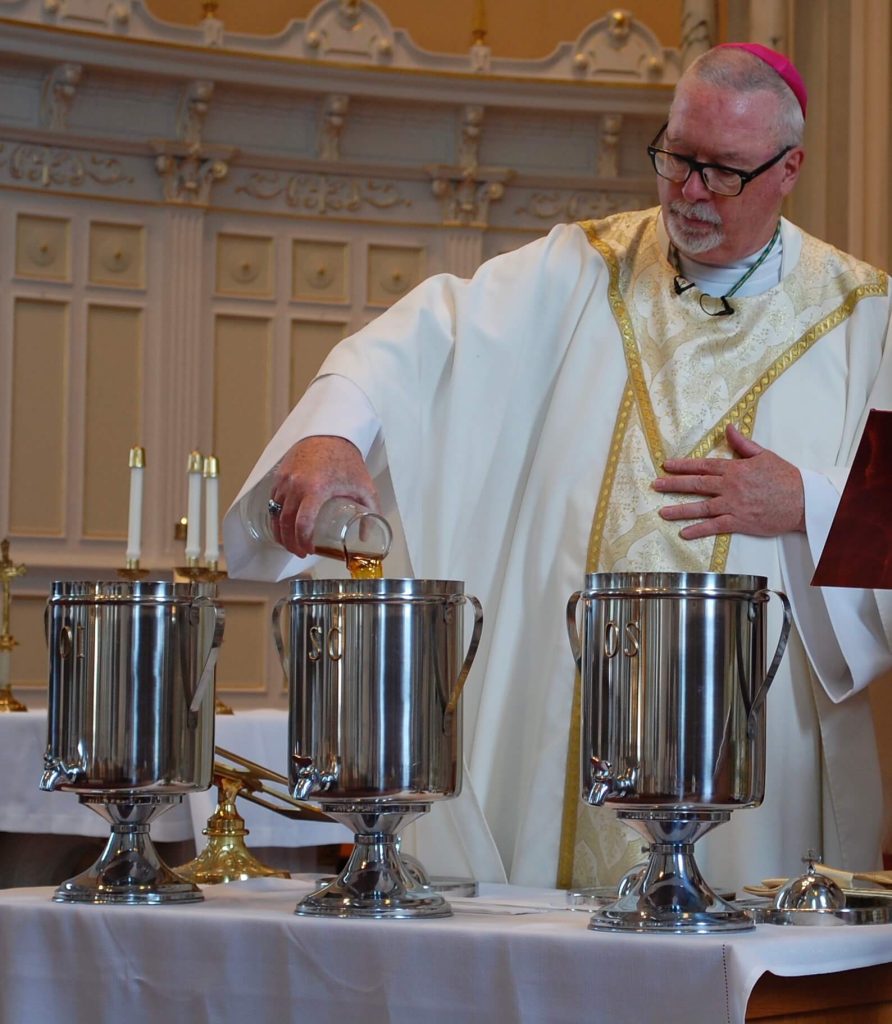
Sacred Chrism is made from a mixture of olive oil and balsam (perfume), representing the fragrance of Christ and the gifts of the Holy Spirit. It is consecrated by the bishop during the Chrism Mass and is used to consecrate individuals, objects, and places for sacred use and service in the Church.
It is used in the administration of the Sacraments of Baptism, Confirmation, and Holy Orders, as well as in the dedication of altars and churches.
Oil of Catechumens (O.C.)
The Oil of Catechumens is made from pure olive oil and is used to strengthen catechumens with the faith needed to renounce evil and commit themselves to following Christ.
Oil of the Sick (O.I.)
The Oil of the Sick is made from pure olive oil and is used in the Sacrament of the Anointing of the Sick to bring healing, comfort, and strength to those who are seriously ill or nearing death.
The holy oils symbolize the outpouring of God’s abundant grace upon His people, the strength He grants them, and the seal of the Holy Spirit upon their lives. These oils must be treated with reverence and care and should never be used for non-sacramental purposes. They are ordinarily kept in the ambry, a special cabinet or shelf in the sacristy reserved for the sacred oils.
Where Do We Get the Holy Oils?
The holy oils are blessed or consecrated annually by the bishop during the Chrism Mass. Parish priests then receive them for use in their respective parishes throughout the year.
What Happens to the Old Oils?
When new oils are received, the old oils must be disposed of according to the norms prescribed by the Church. According to the Book of Blessings (No. 1127), holy oils should be burned reverently or buried in sacred ground. Old oils may only be used in cases of grave necessity (Canon 847 §1).
Who Administers the Sacred Oils?
The administration of the sacraments involving holy oils belongs to ordained ministers. The sacred oils are therefore not at the disposal of the lay faithful, since they are intended exclusively for sacramental use.
2. Oils of the Saints

Besides the three liturgical oils, there is widespread use of devotional oils among the faithful. These oils are traditionally associated with certain saints such as St. Nicholas, St. Philomena, and St. Walburga. This practice is almost as old as the Church itself.
From the earliest centuries of Christianity, believers used oils believed to have come into contact with the relics of saints, especially martyrs, seeking through their intercession spiritual benefits such as healing from bodily and spiritual ailments.
The oils of the saints, sometimes referred to as the Manna of the Saints, are not used because of any intrinsic power in themselves, but because of the spiritual benefits sought through the intercession of the saints with whom they are connected.
According to the classification of relics, oils associated with saints are generally regarded as third-class relics. First-class relics are the bodily remains of saints. Second-class relics are objects that belonged to or were used by saints. Third-class relics are objects that have been touched to a first- or second-class relic.
Some devotional oils are believed to have flowed from the relics of saints, while others are obtained from olive oil used in lamps burning before their shrines or statues.
The Catholic Encyclopedia records that:
“In the days of St. Paulinus of Nola (c. 431) the custom prevailed of pouring oil over the relics or reliquaries of martyrs and then gathering it in vases, sponges, or pieces of cloth. This oil, oleum martyris, was distributed among the faithful as a remedy against sickness.”
Likewise, St. Augustine, in The City of God (Book XXII), recounts instances in which miracles were attributed to the oil associated with St. Stephen. He documents several such occurrences, demonstrating the deep veneration of relics among Christians in the early centuries of the Church.
Church Teaching on the Use of Devotional Oils
The use of oils associated with saints continues today among many of the faithful, although such practices do not enjoy official liturgical approval from the Church. Consequently, when devotional oils are used, they belong strictly within the realm of private devotion.
A particular concern today is the growing influence of Pentecostal practices that promote various forms of so-called “anointing oil” which are foreign to the Catholic understanding of devotional oils. Such oils are often marketed under different names and sold at considerable prices, creating confusion among the faithful.
It is important to note that the Church has authorized only three sacred oils for sacramental use: the Sacred Chrism, the Oil of Catechumens, and the Oil of the Sick.
The use of devotional oils is therefore strictly private and falls under the category of sacramentals. Such oils should be blessed by a priest before use. It is not permitted for the lay faithful to anoint a sick person with devotional oil in a manner that could create confusion with the Sacrament of the Anointing of the Sick, whose administration is reserved to a priest.
As with all sacramentals, the faithful should remember that devotional oils are not magical substances. Their value lies in the prayer of the Church, the faith of the believer, and the intercession of the saints, not in any power inherent in the oil itself.
As we continue journeying together through this series, feel free to send in any questions you may have regarding the teachings of the Church on the Sacraments and sacramentals for clarification in future reflections.
End