en English
ar Arabiczh-CN Chinese (Simplified)nl Dutchen Englishfr Frenchde Germanit Italianpt Portugueseru Russianes Spanish
What are you looking for?

Tag Archives: Fr. Constanz Opiyo MCCJ

Exorcism: Understanding a Delicate Sacramental Practice

In our ongoing reflection on sacramentals, we turn to one of the most sensitive and often misunderstood practices in the Church exorcism. What does it truly mean, and how does the Church approach it with wisdom and caution?

By Fr. Constanz Opiyo, Secretary, Doctrinal Commission

What is Exorcism?

Exorcism is a specific form of prayer used by the Church against the power of the devil. It involves invoking the authority of God to drive out or ward off demons or evil spirits from persons, places, or objects believed to be under their influence or at risk of such influence.

At its core, exorcism is an authoritative appeal in the name of God, commanding the evil spirit to depart from the afflicted subject. The term exorcism comes from the Greek exorkizo, meaning “to adjure” or “to bind by oath,” as reflected in biblical usage (cf. Gen 24:3; 1 Kgs 22:16).

Forms of Exorcism

The Church recognizes two main forms of exorcism, each with a distinct purpose:

1. Major (Solemn) Exorcism

This form is performed only in cases of confirmed demonic possession. It is carried out by a priest specifically appointed by the bishop (cf. Canon 1172).

  • It follows an official and solemn rite of the Church.
  • Its purpose is to liberate a person fully under demonic control.
  • Due to its sensitive nature, each diocese typically designates a trained priest as an official exorcist.
  • Lay persons are never permitted to perform solemn exorcism.

2. Minor (Simple) Exorcism

This form is more common and occurs within the Church’s ordinary sacramental life:

  • It is part of the rite of Baptism and the Rite of Christian Initiation of Adults (RCIA).
  • It is accompanied by the anointing with the oil of catechumens, symbolizing protection against evil.
  • Its purpose is preventive, to protect individuals from the oppressive influence of the devil.

In pastoral situations, a priest may also use minor exorcism prayers when there is suspicion of oppression. These typically include:

  • Sacramental confession (where possible)
  • Renewal of baptismal promises (renouncing Satan and professing faith)
  • Prayer for deliverance (deprecative prayer)
  • Optional imperative prayer, always preceded by petitionary prayer
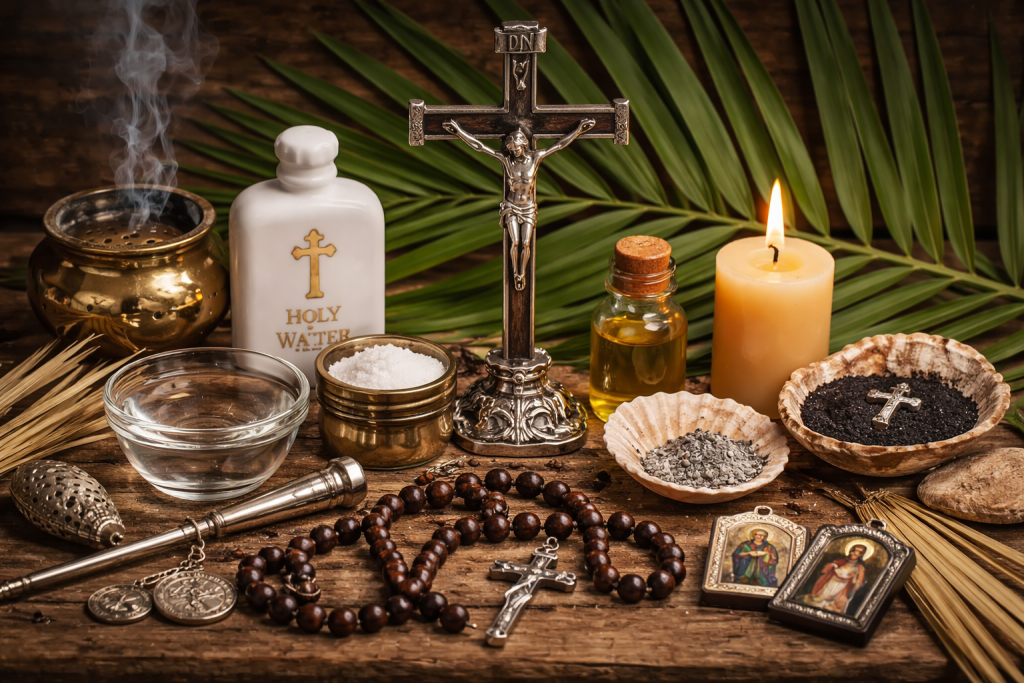
  • Sprinkling with holy water and blessed salt
  • A concluding prayer

Major vs. Minor Exorcism

The difference lies primarily in their purpose:

  • Major exorcism addresses demonic possession, where an evil spirit takes control of a person’s body and actions.
  • Minor exorcism addresses demonic oppression, where a person remains in control but experiences external spiritual attacks or disturbances.

Biblical Foundation

The belief in demonic activity is rooted in Scripture, which teaches that demons are fallen angels who rebelled against God (cf. Is 14:12–15; 2 Pt 2:4; Rev 12:7–9).

  • In the Old Testament, we find examples such as the deliverance of Sarah in the Book of Tobit (cf. Tb 6:8) and the troubled state of King Saul (cf. 1 Sam 16:14–23).
  • The New Testament provides numerous accounts of Jesus casting out demons. Notably:
    • Jesus exercised authority directly, without invoking a higher power.
    • He entrusted this authority to His disciples (cf. Mk 9:14–29).
    • Prayer and fasting are highlighted as essential in spiritual battles.

Scripture also records failed attempts at exorcism, such as the case of the sons of Sceva (cf. Acts 19:13–16), emphasizing that true authority comes from a genuine relationship with Christ.

Exorcism in the Life of the Church

The Catechism of the Catholic Church teaches that:

  • Demons are real but limited creatures, subject to God’s authority (cf. CCC 391–414).
  • Christ has already triumphed over evil, and He shares this victory with the Church.

In the early Church, exorcism was practiced more widely, even among lay Christians. However, over time, the Church restricted it to trained and authorized priests to ensure:

  • Proper discernment
  • Spiritual preparedness
  • Protection from potential harm

This restriction is not a denial of the spiritual power given in baptism, but a pastoral safeguard, recognizing the seriousness of confronting evil.

Pastoral Cautions and Attitudes

Given the delicate nature of exorcism, the Church urges careful discernment:

  1. Do not deny the reality of evil
    Ignoring the devil’s existence can leave one spiritually vulnerable.
  2. Avoid exaggerating the devil’s power
    Fear and obsession can lead to spiritual imbalance. God remains sovereign.
  3. Distinguish between mental illness and possession
    Medical evaluation is essential before any exorcism is considered.
  4. Do not attribute all sickness to demonic causes
    Many conditions require medical, not spiritual, intervention.
  5. Guard against superstition
    Exorcism is not magical. It requires faith, humility, and dependence on God.
  6. Respect Church authority
    Only priests authorized by the bishop may perform exorcism.
  7. Follow the established rite
    Exorcism is a liturgical act, not a spontaneous or improvised prayer.

Conclusion

Exorcism reminds us that the Christian life involves a real spiritual struggle. Yet it also proclaims a deeper truth: Christ has already conquered evil. The Church, through sacramentals and sacramental life, continues to share in that victory.

As believers, we are called not to fear, but to live in faith, vigilance, and trust in God’s power.

Coming Next:
Healing and Deliverance Ministry

Have questions on sacramentals? Send them in to enrich this series.

End
Understanding Sacramentals in the Life of the Church

Commission of Doctrine – Lira Diocese
By Fr. Constanz Opiyo, MCCJ

Introduction

The Commission of Doctrine warmly welcomes esteemed readers of our diocesan website to a series of reflections on topical issues concerning the faith and morals of the People of God in Lira Diocese. We begin with the theme of sacramentals. This week we shall introduce the topic. Your questions will enrich our discussions; therefore, we invite you to read, make comments, and give your questions. We shall try to respond as promptly and exhaustively as we can.

Sacramentals

What are Sacramentals?

Sacramentals “are sacred signs which bear a resemblance to the sacraments. They signify effects, particularly of a spiritual nature, which are obtained through the intercession of the Church. By them, men are disposed to receive the chief effect of the sacraments, and various occasions in life are rendered holy” (Catechism of the Catholic Church, CCC 1667).

They can also be objects or actions instituted by the Church to sanctify the faithful daily. They resemble the sacraments and prepare the faithful to receive grace through the sacraments. Sacramentals help to sanctify various circumstances of life, protect against evil, and foster devotion. Every sacramental involves prayer accompanied by a specific sign like the sign of the cross or sprinkling with holy water.

Examples/Categories of Sacramentals

  • Blessings: given to people, meals, homes, machines, religious objects, etc.
  • Prayers: of exorcism, healing, and deliverance, etc.
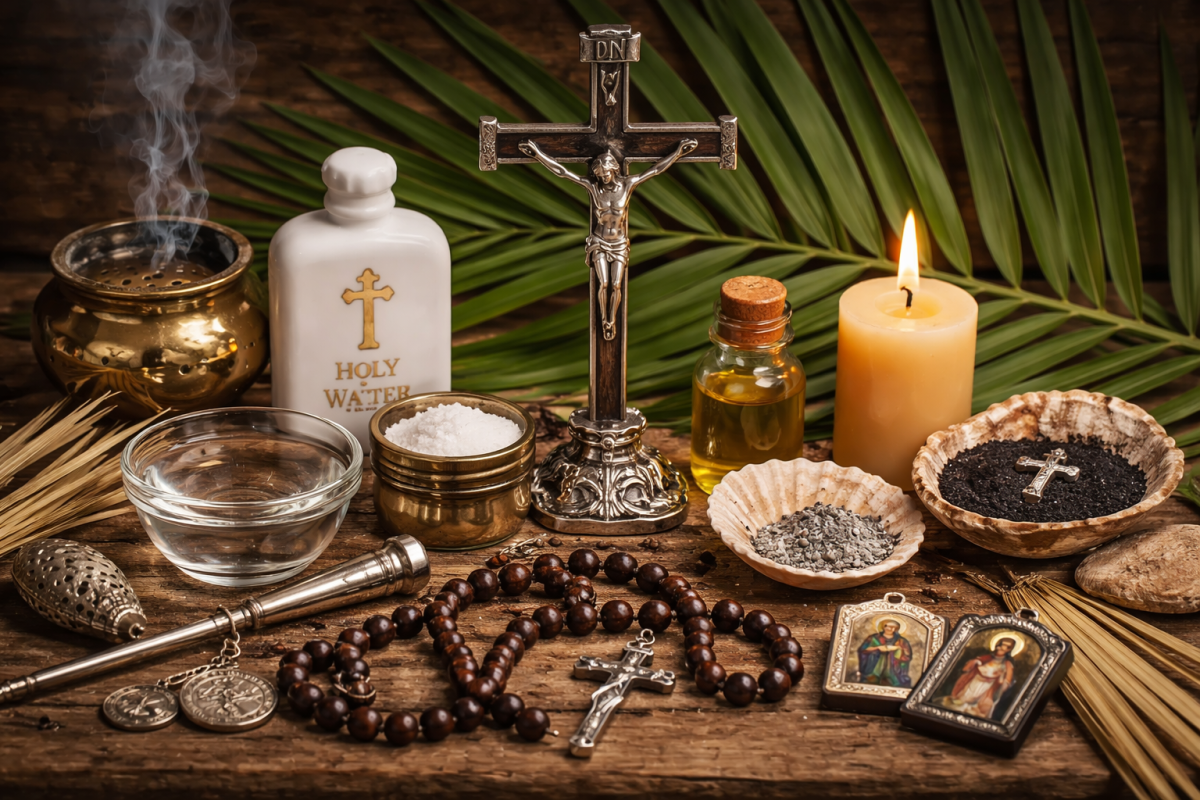
  • Objects: holy water, crucifixes, rosaries, medals, candles, ashes, palms, etc.
  • Actions/Devotions: the sign of the cross, stations of the cross, pilgrimages, exorcism, healing and deliverance, etc.

What is the Difference Between Sacraments and Sacramentals?

Sacraments

Sacraments are visible and efficacious signs of grace instituted by Christ through which God communicates his divine life to us. There are seven sacraments of the Church:

  1. Sacraments of Christian initiation: Baptism, Confirmation, Eucharist
  2. Sacraments of healing: Penance and Anointing of the Sick
  3. Sacraments at the service of communion: Holy Orders and Matrimony

Sacraments are necessary for salvation. Without them, we are deprived of the grace of God that enables us to attain salvation. For example, without baptism, one cannot be called a Christian nor enter the kingdom of God. In John 3:5, Jesus states clearly:

“In all truth I tell you, no one can enter the kingdom of God without being born through water and the Spirit.” By water and spirit is implied the sacraments of baptism and confirmation. Regarding the Eucharist, Jesus says: “In all truth I tell you, if you do not eat of the flesh of the Son of man and drink his blood, you have no life in you” (John 6:53).

Sacraments are absolutely necessary for our salvation and they operate in such a way that the grace conferred by each sacrament is received as it is being administered, provided the conditions for its valid celebration are met. It is termed in Latin as ex opere operato.

Sacramentals

Sacramentals, on the contrary, depend on the faith of the user and the intercession of the Church. They are meant to foster devotion but do not replace the sacraments themselves. While they may be very important because through them we are sanctified or receive graces we need to live in a manner worthy of our Christian calling, they are not absolutely necessary for our salvation.

Examples:

  • When we eat, we begin by blessing the food, recognizing it as a gift from God and at the same time asking Him to make us receive from it the energy we need to work to earn our living. We also recognize in the simple meal a foretaste of the heavenly banquet.
  • When we sprinkle blessed water at home to bless the house and those living in it, we do it by faith that God may bless us and make our home His dwelling place.

By sprinkling the house with blessed water, we show faith in God who came to dwell among us in His Son Jesus Christ.

The Danger of Superstition

However, when we use sacramentals as though they had power in themselves, we have passed from faith to superstition. For example, when water is sprinkled at home without faith, it does not bring the desired effect; God does not come to dwell in that home. Instead, the act becomes devoid of meaning and more of a superstition.

What is Superstition?

Superstition is when one sees an object as having power in itself, not as a sign. Superstition is when we believe that certain objects have power in themselves and we use them not out of faith in God but out of our belief that the object possesses its own power capable of bringing the desired effect.

The use of sacramentals should never degenerate into superstition. There are objects we use such as water, salt, oil, incense, etc. They are used by faith and through the intercession of the Church to sanctify our lives daily, but not because of any power they have of their own. When we think salt has power in itself, then it is superstition.

Some Possible Questions That May Arise

Question 1:

What about our grandparents and ancestors who died without receiving baptism or any other sacrament? Are they condemned to hell fire?

Response:

Luke 12:47-48 states:

“The servant who knows what his master wants, but has got nothing ready and done nothing in accord with those wishes, will be given a great many strokes of the lash. The one who did not know, but has acted in such a way that deserves a beating, will be given fewer strokes. When someone is given a great deal, a great deal will be demanded of that person; when someone is entrusted with a great deal, of that person more will be expected.”

Jesus tells us that the person who does not know even if he has acted wrongly cannot suffer the same magnitude of punishment as the one who knows. Our ancestors lived at a time when they did not know God as revealed by Jesus Christ, yet even in their traditional religion, they sought to know God and to serve Him. Every people and culture had their own approach to religion and morality. Concepts of good and evil are universal and are known beyond the confines of Christianity.

Therefore, our ancestors who lived good moral lives do in fact share the glory of heaven, because they sought to know God, serve Him, and live in a worthy manner. However, those ancestors who were wicked suffer the consequence of their actions. Their punishment may not be as severe as for those who have been enlightened by the Gospel of Christ. This is the reason why we pray for the souls in purgatory. For us today who have received the Gospel, we cannot excuse ourselves. We need the sacraments for our salvation.

Question 2:

How do I know if I am using a sacramental according to the faith of the Church and not acting in a superstitious manner?

Response:

In Acts 8:9-24, we find information on a certain man called Simon the magician. He was baptized and became a Christian by the deacon Philip, but he did not abandon his former life of witchcraft. He tried to bribe Peter and John when he saw them praying over the people to receive the Holy Spirit. He thought Peter and John had the power to give the Holy Spirit to people they laid their hands on and that he could pay them to give him some of their power to do the same.

Simon needed the power so that he could make money from his magic performances. Simon did not recognize that the power or authority to give the Holy Spirit comes from God and not from the apostles themselves. This is exactly what we call superstition.

When we think we have power in ourselves to lay hands on others so that they are healed or receive some grace, we become magicians. It is God who gives the power and authority. The authority does not come from us.

Similarly, when we think an object like salt has power in itself and not as a sign of God’s grace working through the blessed object, we are acting in a superstitious way. For example, if I sprinkle salt around the house thinking that the salt will protect my house instead of God Himself, I am acting in a superstitious manner.

Psalm 127:1 says:

“If Yahweh does not build the house, in vain do its builders toil. If Yahweh does not guard the city, in vain does its guard keep watch.”

It is clear therefore that the power comes from God and not from us. Sacramentals are used with faith in God who acts through these visible signs to bring to us His blessings, protection, and divine life.

Add Your Questions to Enrich the Topic

Readers are invited to submit their questions, which will enrich the discussion.

Next Topic

First Category of Sacramentals: Blessings

Fr. Constanz Opiyo, MCCJ
Secretary, Doctrinal Commission
Lira Diocese