By Fr. Isaac Ojok, Communications Office, Lira Diocese
Dokolo Catholic Parish has launched a fundraising campaign to raise UGX 600 million for the renovation of its parish church, which has developed structural challenges after decades of use.
The fundraising drive will culminate in a Grand Fundraising event on September 26, 2026, at the parish, as the Catholic community seeks to restore and improve the historic church.
The parish priest, Rev. Fr. Augustine Odongo, said the renovation project is ready for implementation once the required funds are mobilised.
He said the estimated cost of the project is UGX 600 million and that the renovation is intended to address the deteriorating condition of the church while creating a safer and more conducive environment for worship.
“This project is not merely about repairing a building. It is about preserving our spiritual home and creating a safe, dignified, and welcoming place where future generations can continue to encounter Christ,” Fr. Odongo said.
The church, which serves as the headquarters of Dokolo Deanery, has been affected by years of use, with the ageing iron-sheet roof leaking during heavy rains and cracks developing in parts of the walls.
The parish also says the growing number of faithful has created a need for additional space, while the renovation will seek to modernise and beautify the church without losing its historical and spiritual character.
A parish with a long history
Founded in 1958 and dedicated to St. Francis Xavier, Dokolo Catholic Parish has grown into an important centre of evangelisation in the Diocese of Lira.
The parish currently has 61 chapels, excluding those under Bata Sub-Parish, and serves a number of primary and secondary schools within its pastoral jurisdiction.
It also coordinates pastoral activities among the neighbouring parishes of St. John Fisher Amolatar, St. Luke the Evangelist Aputi, St. Francis of Assisi Abuli and Our Lady of Fatima Agwata.
Over the years, the parish has contributed to the growth of the Catholic Church through vocations, producing seven diocesan priests, while several deacons and seminarians continue their formation.
The parish community is largely dependent on agriculture and small-scale businesses for its livelihood and is characterised by the peaceful coexistence of the Lango and Kumam communities.
Renovation to support pastoral ministry
According to the parish leadership, the renovation is expected not only to improve the physical condition of the church but also to strengthen pastoral activities, faith formation and the parish’s wider social and educational programmes.
The parish says the improved church will provide a more suitable environment for worship and enable it to continue serving as a centre for evangelisation and community engagement.
During the recent pastoral visit of Rt. Rev. Sanctus Lino Wanok, Bishop of Lira Diocese, to Dokolo Deanery, parish leaders, youth, women and other stakeholders expressed their commitment to the renovation project.
Their support, according to the parish, reflects a shared desire to preserve the church’s history while preparing it to serve future generations.
Grand fundraising event
Fr. Odongo said the main fundraising event will take place at Dokolo Catholic Parish on September 26, 2026.
The event is expected to attract government officials, Members of Parliament, local leaders and other invited guests. The communication says Rt. Hon. Robinah Nabbanja, Prime Minister of Uganda, is expected to attend, alongside other cabinet ministers and distinguished guests.
The parish has appealed to parishioners, members of the diaspora, friends of the Church, development partners and other people of goodwill to support the renovation campaign.
The initiative forms part of wider efforts within Lira Diocese to improve Church infrastructure. Similar renovation works are ongoing at Assumption of the Blessed Virgin Mary Bala Parish, where Christians are renovating the presbytery, and at St. Paul’s Catholic Parish Aboke, where renovation of the parish church is also underway.
The parish leadership says contributions towards the Dokolo Catholic Parish Church renovation can be made through the parish priest, Rev. Fr. Augustine Odongo, or the assistant parish priest, Rev. Fr. George Ochieng.
For contributions and further information: Rev. Fr. Augustine Odongo – Parish Priest: +256 778 975 538 Rev. Fr. George Ochieng – Assistant Parish Priest: +256 770 453 858
The parish has placed the project under the words of Psalm 127:1: “Unless the Lord builds the house, the builders labour in vain.”
By Flavia Oyuu, Communications Office, Lira Diocese
Land stakeholders in Dokolo District have called for stronger collaboration between community-based paralegals, local government authorities, land governance institutions, police and other justice actors to prevent land disputes from escalating into costly court battles.
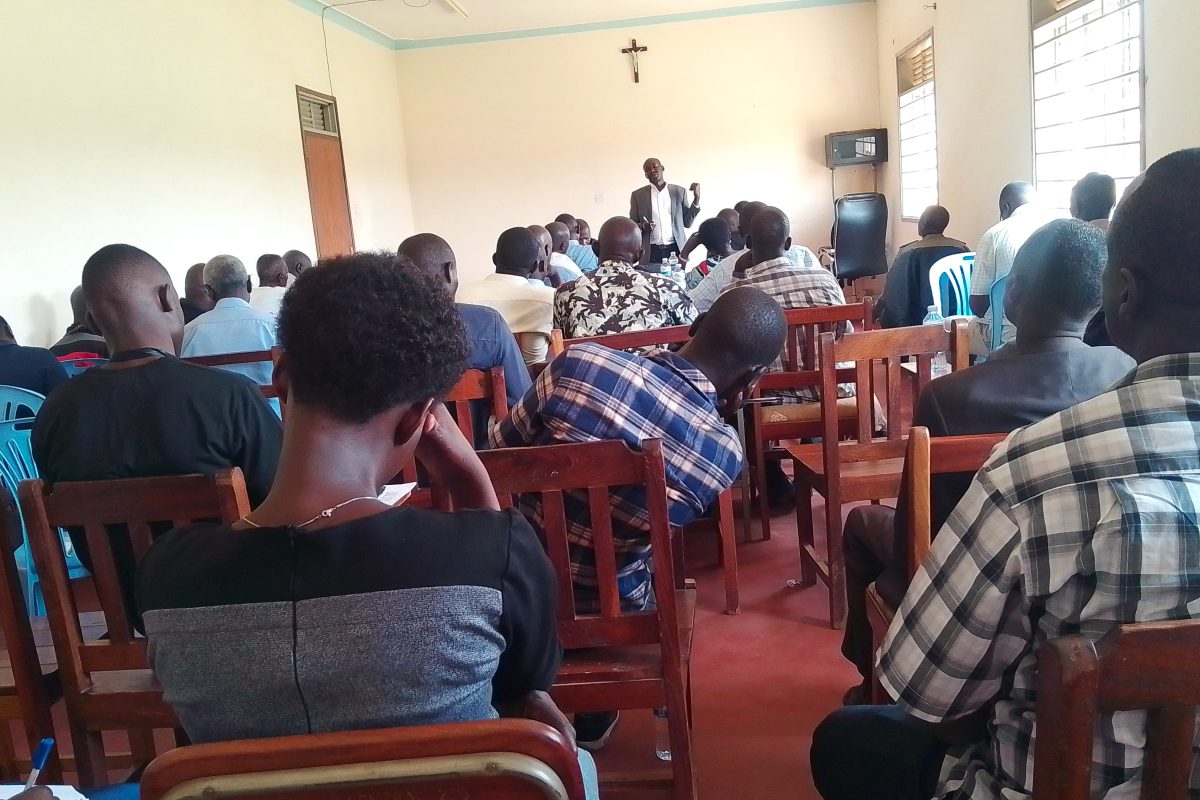
The call was made on Tuesday, August 11, 2026, during a stakeholder engagement meeting held at the Daniel Comboni Offices in Bar Ogole, Lira City, under the theme “Strengthening the Functionality of Community-Based Paralegals Through Collaboration with Decentralised Justice and Land Governance Institutions.”
The meeting, organised by PELUM Uganda in partnership with Caritas Lira, brought together about 60 participants, including community-based paralegals, police officers, Dokolo District Land Board members, Area Land Committee members, sub-county chairpersons, LC1 leaders, civil society organisations and other stakeholders involved in land governance and justice.
The meeting served as a quarterly reflection for community-based paralegals working in Dokolo District and its sub-counties, particularly Amwoma Sub-county, where the paralegals have been trained to provide basic legal awareness, support communities to understand their land rights and help mediate disputes within their communities.
PELUM Uganda Program Manager for Advocacy, James Cleto Mumbere
Speaking during the meeting, PELUM Uganda Program Manager for Advocacy, James Cleto Mumbere, said the organisation works with member organisations, including Caritas Lira, to strengthen the capacity of communities to sustainably manage their resources and protect their land rights.
He said the meeting was intended to strengthen collaboration among the different institutions involved in land matters and assess how the paralegals were carrying out their work.
“We are here today to have a quarterly reflection meeting with the community-based paralegals,” Mumbere said, adding that the engagement also brought together district land boards, Area Land Committees, police, civil society organisations and representatives of religious and cultural institutions.
He said the discussions focused on how paralegals were sensitising communities about land rights, creating awareness and mediating cases that fall within their capacity.
According to Mumbere, the work of the paralegals is beginning to extend beyond land matters, with some being entrusted by their communities to monitor children who are absent from school.
He said secure land tenure was also important for agricultural production and food security because farmers were unlikely to invest confidently in their land where ownership remained uncertain.
Prevent disputes before they reach court
A major concern raised during the meeting was the financial and social burden associated with prolonged land cases in courts of law.
Counsel Egum Moses urged community-based paralegals to focus on prevention and alternative dispute resolution, while recognising the limits of their mandate and referring complex cases to the appropriate institutions.
He said early intervention could prevent disputes from developing into prolonged court cases, which often require significant financial resources and may take years to resolve.
Moses encouraged the paralegals to work with religious leaders, cultural leaders, clan leaders and other recognised community structures where appropriate to resolve disputes peacefully before they escalate.
He also emphasised the importance of proper documentation when acquiring land.
He advised people buying land to ensure that agreements clearly indicate the land being purchased, its size, location, purchase price, payment arrangements, date and witnesses.
He noted that informal or incomplete agreements can become a source of conflict when circumstances change or one of the parties later disputes the transaction.
The need for proper documentation was also linked to land registration and security of ownership, with participants encouraged to take steps to have their land properly documented and registered.
Land disputes affecting women, children and other vulnerable people
The meeting also highlighted the vulnerability of women, children and other disadvantaged groups in land-related disputes, particularly in matters involving inheritance and succession.
Moses urged stakeholders to promote women’s land rights and ensure that widows and children are not unfairly deprived of land following the death of a family member.
He also raised concerns about the consequences of people dying without wills, particularly in families where there are multiple spouses and children.
The discussions revealed that lack of knowledge about land laws, family inheritance disputes, inadequate documentation, corruption and political interference continue to complicate land governance.
Participants also identified disputes involving children’s inheritance as one of the issues requiring greater community sensitisation.
At one point, the facilitator asked participants how many had already prepared their wills. The room fell silent, with only one participant indicating that he had a rough sketch of a will.
The moment underscored the need for greater awareness about succession planning and the importance of putting one’s wishes in writing before death.
Dokolo Land Board reports progress in land registration
The Chairperson of the Dokolo District Land Board, Moses Ejor Ongom
The Chairperson of the Dokolo District Land Board, Moses Ejor Ongom, explained the role of the District Land Board and Area Land Committees in the land registration process.
He said the District Land Board works alongside Area Land Committees, which play an important role in verifying applications and ensuring that necessary procedures are followed before applications are approved.
The board also handles applications for different forms of land ownership and plays a role in determining compensation rates for land affected by government projects.
The meeting heard that efforts to sensitise communities about land registration have resulted in increased applications for registration in the district.
According to information shared during the meeting, the District Land Board has received about 6,000 files for land registration, approved approximately 4,000 and uploaded about 400 onto the Land Information System.
The progress was presented as an indication of growing awareness among communities about the importance of securing formal documentation for their land.
Police call for early intervention
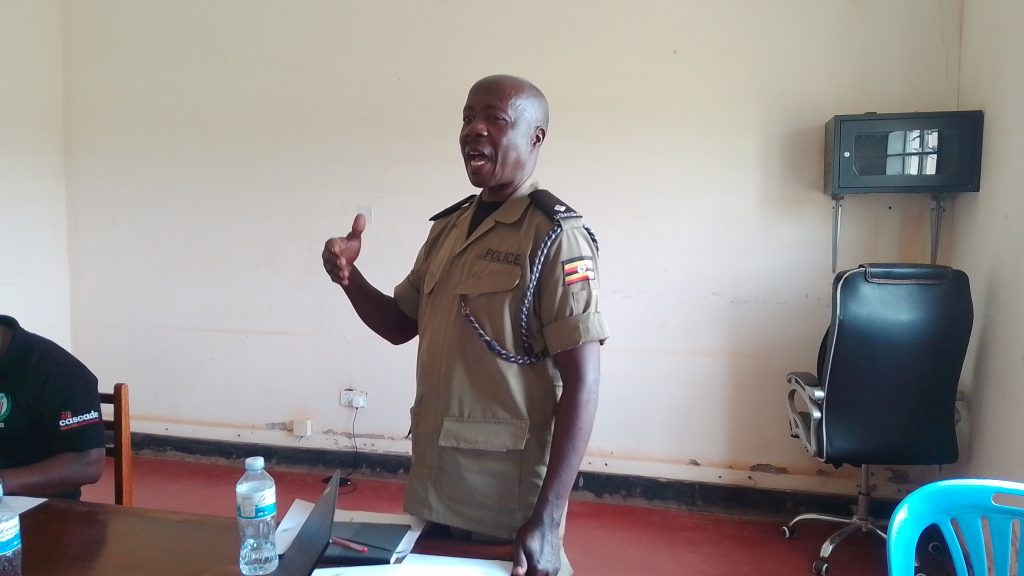
Officer in Charge of Amwoma Police Station and Community Liaison Officer, Olwit Joseph
The Officer in Charge of Amwoma Police Station and Community Liaison Officer, Olwit Joseph, said police have an important role in preventing crimes that may arise from land disputes, although land ownership disputes themselves are generally handled through the appropriate land governance and justice institutions.
He said land conflicts can sometimes result in criminal offences including fighting, assault, malicious damage and, in serious cases, murder.
He explained that police work with Area Land Committees and other relevant institutions when dealing with land-related complaints, while intervening where criminal offences have been committed.
The police therefore encouraged community structures to identify and address conflicts before they develop into criminal incidents.
Paralegals taking justice closer to communities
Community-based paralegals trained by Caritas Lira are drawn from the communities they serve, with about ten trained paralegals operating in each participating sub-county.
Their role is particularly important for vulnerable people who may not have the financial means or knowledge required to pursue cases through formal courts.
Through sensitisation and mediation, the paralegals help community members understand land ownership, inheritance, succession, women’s rights and other aspects of land governance, while referring matters beyond their capacity to the appropriate authorities.
One of the experiences shared during the meeting demonstrated how the model is beginning to take root at community level.
A trained paralegal from Amwoma explained that after completing his training, his LC1 leadership handed over land-related matters in the community to him. He subsequently organised a community meeting attended by residents, the LC1 chairperson and members of the local leadership, through which land issues were discussed and addressed.
His responsibilities have since expanded beyond land matters. He was also asked to help monitor school attendance in the community, moving from household to household to establish whether parents were sending their children to school.
For PELUM Uganda and Caritas Lira, the experience demonstrates how trained community members can become important links between vulnerable communities and formal justice, land governance and local government institutions.
Stakeholders call for continued sensitisation
The participants agreed that communities still require more information about land laws, land registration procedures, inheritance, succession and the rights of women and children.
Caritas Lira Program Coordinator Francis Ojok said the engagement was intended to strengthen coordination among the different actors involved in land matters and help communities understand the correct procedures for acquiring and securing land.
He said land remains a primary factor of production and that people need to understand the steps involved in lawfully acquiring and securing ownership.
The LC3 Chairperson of Amwoma Sub-county, Opono Denis, urged participants to take the lessons from the meeting back to their communities, saying many conflicts are rooted in limited knowledge and poor planning.
He called for continued community sensitisation and encouraged stakeholders to work towards transforming land-related conflicts into peaceful solutions.
The meeting ended with a renewed call for stronger collaboration between community-based paralegals and decentralised justice and land governance institutions so that disputes can be identified and addressed early.
The stakeholders emphasised that prevention, awareness and peaceful mediation should remain the first line of response, while cases that fall outside community mechanisms should be referred to the appropriate land, police or judicial institutions.
For communities where land is the foundation of homes, agriculture and livelihoods, the message from the meeting was clear: knowing one’s rights, documenting ownership and resolving disputes early can prevent a land disagreement from becoming a much bigger problem.
By Flavia Oyuu, Communications Office, Lira Diocese
LIRA CITY, August 6, 2026 – Lira Diocese on Thursday celebrated one of the largest ordinations in its history as Rt. Rev. Sanctus Lino Wanok ordained 11 priests and eight deacons, calling on them to embrace lives of holiness and selfless service by taking Christ to the poor, the sick, the broken-hearted and those on the margins of society.
The solemn Eucharistic celebration, held on the Feast of the Transfiguration of the Lord at Uganda Martyrs Cathedral Ordination Grounds, attracted thousands of faithful who packed the ordination grounds. The Mass was concelebrated by Bishop Emeritus Joseph Franzelli, dozens of priests from Lira Diocese and other dioceses in Uganda and Kenya, religious sisters and brothers, government officials, traditional leaders, families of the ordinands and Christians from across the diocese.
The 11 newly ordained priests are Rev. Fr. Ambrose Oroma of Iceme Catholic Parish, Rev. Fr. Dicken Opoo of Otwal Parish, Rev. Fr. Samson Odongo of Lira Cathedral Parish, Rev. Fr. Ambrose Adupa of Aber Parish, Rev. Fr. Jimmy Dila of Aboke Parish, Rev. Fr. Emmanuel Okello of Anyeke Parish, Rev. Fr. Isaac Opio of Te-Boke Parish, Rev. Fr. Caesar Opio of Lira Cathedral Parish, Rev. Fr. Lawrence Ojok of Anyeke Parish, Rev. Fr. David Onyango of Omoro Parish and Rev. Fr. Brian Obong of Agweng Parish.
The newly ordained deacons are Caesar Ajuk of Dokolo Parish, Joseph Etot of St. Jude Parish, Steven Ocen of Alanyi Parish, Christopher Ogwal of Dokolo Parish, Caesar Tyan of Amolatar Parish, Morris Ogwang of Te-Boke Parish, Denis Hamson Obua of Ober Parish and Fredik Onyango of Aber Parish.
The ordination marked the highest number of priests ordained at one time in the history of Lira Diocese. It also celebrated a significant milestone with the ordination of Rev. Fr. Ambrose Oroma into the Congregation of the Apostles of Jesus (AJ), the first priest from the congregation to be ordained in the diocese in about 20 years.
Aber Deaneyr Choir animating this year’s ordinations
The celebration was filled with emotion as some of the deacons shed tears after responding, “Here I am,” when their names were called by the Bishop before being presented by their parish priests. Parents and guardians proudly handed over their sons to the Bishop, symbolizing their offering to the service of God and the Church.
The liturgy featured the traditional rites of priestly ordination, including the Litany of Saints during which the priesthood candidates lay prostrate before the altar in total surrender to God, followed by the laying on of hands and the Prayer of Ordination. The choir from Aber Deanery animated the celebration with hymns throughout the Mass.
Drawing his homily from the Feast of the Transfiguration, Bishop Wanok reminded the newly ordained ministers that the glory experienced on the mountain was only a preparation for the mission awaiting them among God’s people.
“Today you ascend the mountain not to remain here but to descend into the villages, the schools, the hospitals, the prisons, the parishes and families where Christ waits to be served,” the Bishop said.
He explained that just as Jesus led His disciples down from Mount Tabor after revealing His glory, priests and deacons are called to leave moments of celebration and dedicate themselves to serving people in their daily struggles.
The Bishop urged the newly ordained clergy to make holiness their first priority, saying the Church needs ministers rooted in prayer more than activity.
“People do not first need very busy priests or ministers. They need holy priests and ministers who are available,” he said.
He encouraged them to remain faithful to prayer, the Eucharist and the Sacrament of Reconciliation, warning that ministry without prayer easily becomes mere performance.
“Never allow administration to replace adoration,” he cautioned. “Spend time before the Blessed Sacrament because it is there that you receive the strength to nourish God’s people spiritually.”
Bishop Wanok further challenged the priests and deacons to become faithful servants of the Gospel, resisting the temptation to preach personal opinions or seek popularity.
“Our people are surrounded by many voices—politics, social media, tribal divisions and false promises. They need to hear the voice of Christ from you,” he said.
Quoting the rite of ordination, he reminded them: “Believe what you read, teach what you believe and practice what you teach.”
Speaking about their pastoral mission, the Bishop said their priesthood would be lived not in comfort but among ordinary people facing life’s hardships.
He told them they would encounter broken marriages, abandoned children, struggling youth, families burdened by poverty, elderly people who have been forgotten, prisoners, the sick and the dying.
“Go to them. Walk with them. Listen before speaking. Heal them before judging. Welcome them before condemning them,” he said.
The Bishop reminded the new priests that from the day of ordination they become spiritual fathers to God’s people.
“People will call you Father. This title is not an honour but a responsibility. They are asking you to help them know God,” he said.
Addressing the families of the newly ordained clergy, Bishop Wanok thanked parents and relatives for nurturing vocations within their homes through prayer and sacrifice.
“You have presented these sons to the Church. Continue praying for them. They now belong to a larger family—the family of Lira Diocese,” he said.
He concluded by reminding the ordinands that priesthood is a lifelong mission of sacrifice rather than prestige.
“Today these men do not receive crowns; they receive crosses. They are not coming for comfort but for mission,” the Bishop said, encouraging them to remain faithful to Christ throughout their ministry.
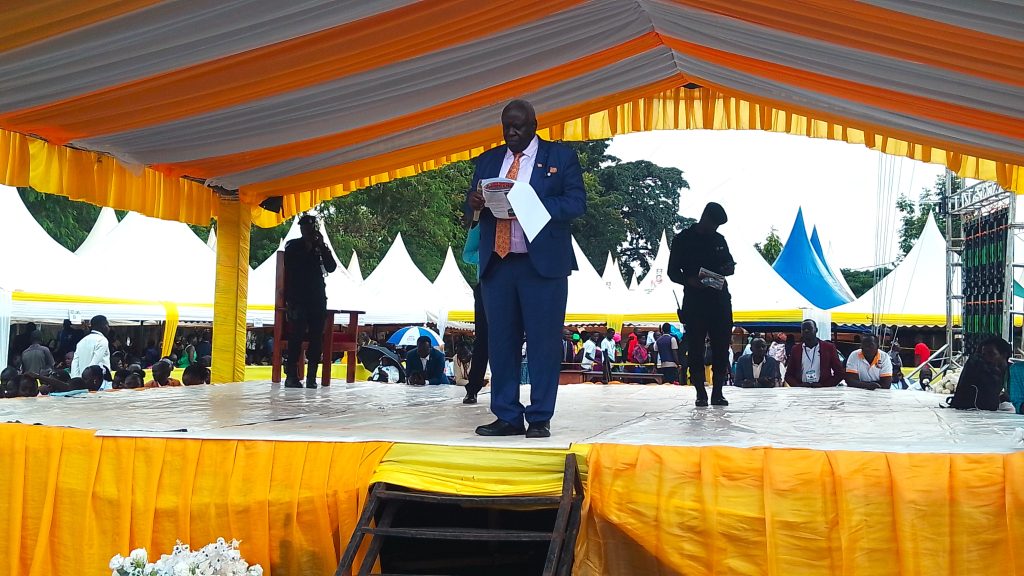
The Minister for Disaster Preparedness and Refugees and Erute South Member of Parliament, Hon. Sam Engola
The Minister for Disaster Preparedness and Refugees and Erute South Member of Parliament, Hon. Sam Engola, who was the chief guest, congratulated the newly ordained clergy for responding to God’s call and urged them to remain humble servants of the people.
“As you begin your ministry, preach the Word of God, guide the faithful to God’s mercy through the Sacrament of Reconciliation and proclaim the Gospel with truth and passion,” he said.
Quoting Matthew 20:28, Hon. Engola reminded them that Christ “did not come to be served but to serve,” urging them to remain close to the poor and serve God’s people with love and sacrifice.
The Paramount Chief of Lango, His Highness Eng. Dr. Michael Odongo Okune, called on the people of Lango to protect the environment through tree planting to replace trees lost to deforestation.
He also encouraged households to improve sanitation by constructing and using latrines, expressing concern over continued open defecation in some communities. He further urged political leaders to remain accessible to the people they serve and to listen attentively to the concerns of their constituents.
The celebration concluded with thanksgiving, blessings and joyful celebrations as families, friends and Christians congratulated the newly ordained priests and deacons on the beginning of their sacred ministry in the Church.
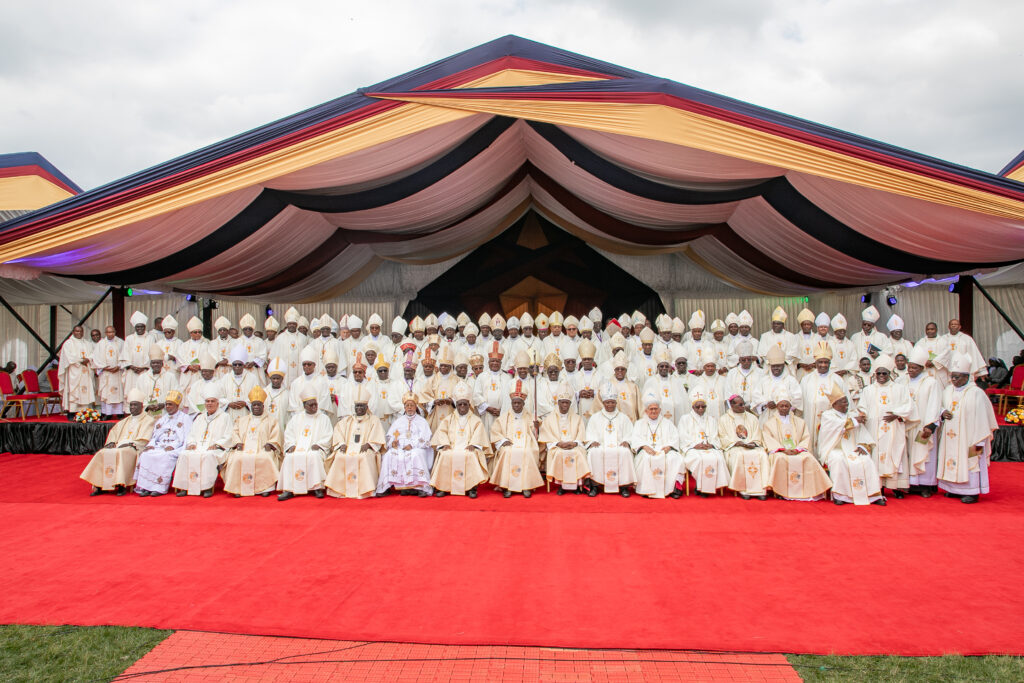
At the closing Mass of the 21st Plenary Assembly of the Association of Member Episcopal Conferences in Eastern Africa (AMECEA) on Sunday, July 26, the bishops resolved to listen to and walk with the young people in the region over the next four years.
“We love you, we believe in you, and we invite you to participate fully in the life and mission of the Church and in the life of your respective countries,” Bishop Martin Mtumbuka of Karonga Diocese, Malawi, read the communiqué issued at the end of the week-long plenary.
In his message on behalf of the Bishops, more than 15,000 young people from Kenya and across the region animated the opening Eucharistic celebration, filling the compound of the Catholic University of Eastern Africa (CUEA) with song.
The voice of the young people, the bishops noted, was a clarion call to Church leaders, parents and other stakeholders to create more time and space for youth participation in leadership and decision-making. The young delegates also turned the challenge on themselves, committing to remain open to learning, discerning and embracing emerging opportunities.
The bishops pointed out that the youth are God’s children who need understanding, accompaniment, deeper catechesis and holistic formation, grounded in Catholic Social Teaching and attentive to the signs of the times.
In their resolutions, the bishops committed to strengthening pastoral accompaniment and youth chaplaincies, and to deepening catechesis and faith formation explicitly including responsible engagement with Artificial Intelligence (AI), social media and other emerging digital technology. They resolved to form Catholic digital missionaries for evangelization in the digital age.
Besides, the Small Christian Communities (SCCs), which are the backbone of Church life in Eastern Africa, are to be revitalized as spaces of healing and belonging, with hybrid online communities being part of the model. The family is to be supported as the first school of faith and identity.
In their response to young people, the Church leaders said mental health and psycho-social support and services are to be expanded. Safeguarding policies, formation and youth-led accountability are also to be strengthened, with young people themselves at the forefront.
On governance, the bishops pledged to promote transparent leadership and youth co-responsibility in both Church and civic life, including creating and strengthening dedicated youth desks. While on livelihoods, they committed to investing in education, mentorship, entrepreneurship and skills development, as they resolve to deepen the shared regional spirit of collaboration and solidarity among member Conferences.
The assembly also resolved to advocate for the safe and lawful free movement of citizens within the region, to address the root causes of forced migration, and to support policies protecting migrants and refugees across the AMECEA region.
Reminding the people of God of the message from His Eminence Michael Cardinal Czerny, Prefect of the Dicastery for Promoting Integral Human Development, Bishop Mtumbuka read that the Cardinal urged young people to embrace dialogue as an essential ingredient for fostering love, unity and peace, and for restoring trust among people and nations.
According to the Sunday communiqué, young people are not asked to wait for the Church to act on their behalf; but they are asked to sit in the rooms where decisions are made on youth desks, in accountability structures, inside the safeguarding mechanisms meant to protect young people.
By Fr. Constanz Opiyo Commission of Doctrine, Lira Diocese
Dear readers,
As we continue our journey through this series on sacramentals in the life of the Church, we now turn our attention to some of the other objects commonly used in Catholic worship and private devotion. Many of these are familiar to us and are frequently seen in our churches and homes. Understanding their meaning helps us to appreciate them not merely as religious objects but as signs that deepen our faith and draw us closer to God.
In this reflection, we conclude our discussion on some of the most common objects used either in the Church’s public liturgy or in private devotional life.
1. Incense
Incense has always occupied an important place in the worship of God, as we read in Sacred Scripture. In Exodus 30:34–37, God instructs Moses to prepare incense specifically for divine worship and forbids its manufacture for ordinary personal use, declaring it to be “holy, reserved for the Lord.”
In the Catholic liturgy, following this biblical tradition, incense symbolizes sanctification, purification, and the prayers of the faithful rising to God, as expressed in Psalm 141:2 and Revelation 5:8.
Incense is used during solemn celebrations of the Holy Mass, funerals, processions, and Eucharistic Adoration. During the liturgy, it honours Christ, who is the principal actor in every celebration: Christ present in the priest acting in persona Christi, Christ present in the gathered assembly who form His Mystical Body, and Christ present upon the altar where the sacrifice of Calvary is made sacramentally present.
The rising smoke symbolizes the prayers of the faithful ascending to heaven, while its fragrance signifies the presence of God and the pleasing aroma of Christ.
During Mass, incense is ordinarily used during the Entrance Procession, the proclamation of the Gospel, the Preparation of the Gifts, and the elevation of the Sacred Species during the Eucharistic Prayer.
The incense grains are kept in a small container called the boat, while burning charcoal is placed in a thurible (censer). The priest blesses the incense before placing it on the burning charcoal for use during the liturgy.
Whenever incense is used, it reminds us that we are standing in a sacred place and in the presence of God.
Incense intended for liturgical worship should not be taken home for private devotional use outside the liturgical celebration.
2. Crucifix
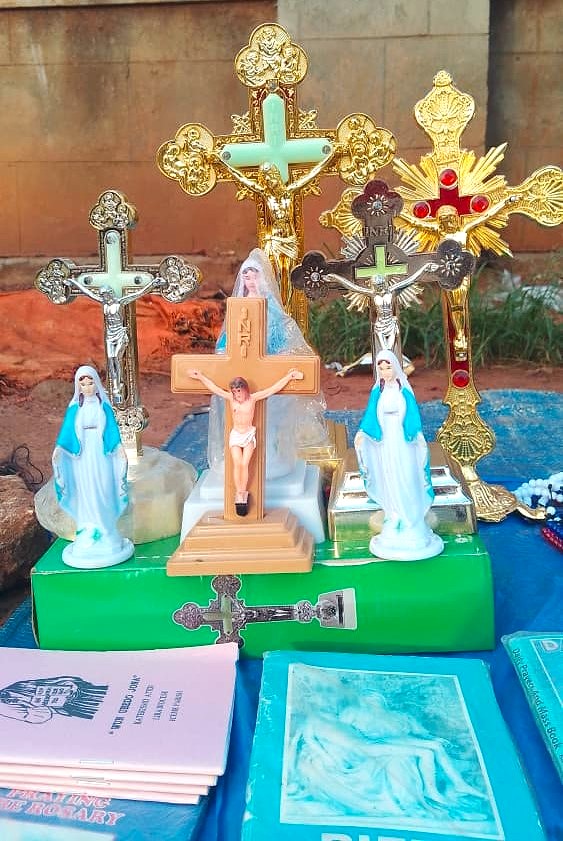
A crucifix is the representation of Christ crucified upon the Cross for the salvation of humanity.
It is a commendable Christian devotion to wear a crucifix or to display one in the home. It serves as a constant reminder of Christ’s supreme sacrifice through which our salvation was won.
A crucifix intended for devotional use should be blessed by an ordained minister before being used.
3. Rosaries, Medals and Scapulars
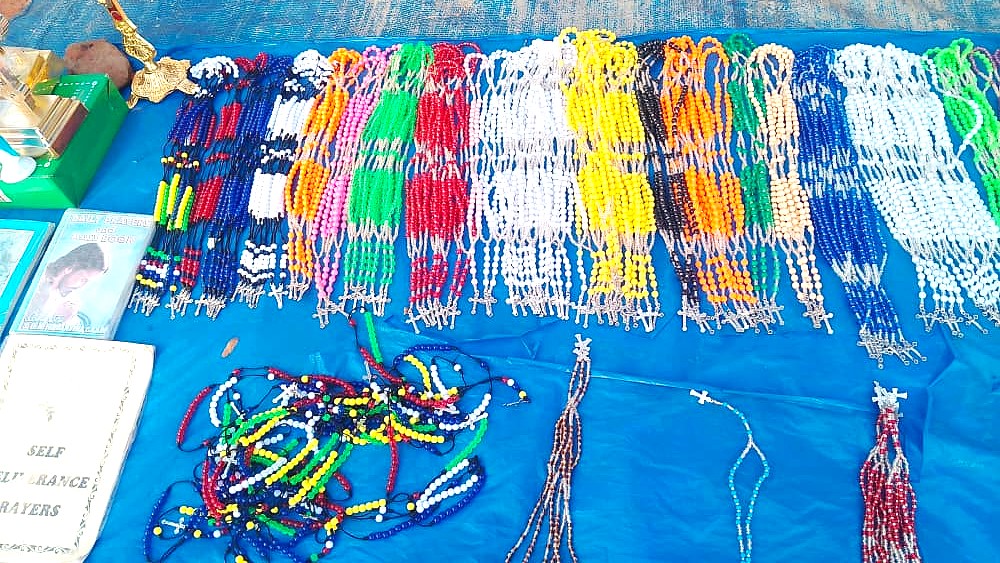
These are devotional articles commonly used in Marian and other approved devotions within the Church. They serve as valuable aids to prayer and should therefore be treated with reverence and respect.
Nevertheless, it is erroneous to think that these objects possess power in themselves. Their purpose is to assist the faithful in prayer. Every prayer offered with these devotional articles is ultimately directed to God through the intercession of the Blessed Virgin Mary or the saints.
Rosary
The Rosary is a devotional aid that assists the faithful in meditating, together with the Blessed Virgin Mary, on the mysteries of Christ’s saving work.
It consists of a crucifix, three introductory beads leading to the centre medal, and five decades separated by larger beads for the Our Father.
The Rosary is fundamentally a scriptural and meditative prayer.
Pope St. John Paul II describes it as “a prayer loved by countless Saints and encouraged by the Magisterium” (Rosarium Virginis Mariae, 1). Although it is a Marian devotion, it “is at heart a Christocentric prayer.” He further observes that “in the sobriety of its elements, it has all the depth of the Gospel message in its entirety,” making it “a compendium of the Gospel.” Through the Rosary, the faithful receive abundant graces “as though from the very hands of the Mother of the Redeemer.”
Besides the Rosary of the Blessed Virgin Mary, other forms of prayer have developed using similar beads, commonly known as chaplets, such as the Chaplet of Divine Mercy and the Chaplet of the Precious Blood.
Scapular
The scapular consists of two small rectangular pieces of wool joined together by strings and worn over the shoulders.
Its origin lies in the religious habit worn by monks, where a long piece of cloth draped over the shoulders served initially as a work apron before acquiring profound spiritual symbolism. It came to represent the yoke of Christ borne by those wholly dedicated to His service, reminding them of humility, obedience, and faithful service.
Later, the faithful adopted a smaller version as a sign of sharing spiritually in the life and devotion of particular religious communities.
The most familiar is the Brown Scapular of Our Lady of Mount Carmel, originating from the Carmelite Order. It is worn as a sign of consecration to Our Lady and trust in her maternal protection.
Other scapulars include the Green Scapular, bearing the image of the Immaculate Heart of Mary; the Red Scapular in honour of the Passion of Christ; and the White Scapular, symbolising devotion to the Holy Trinity.
Like the original monastic scapular, these devotional scapulars remind Christians to take upon themselves the yoke of Christ (cf. Matthew 11:29).
Medals
Devotional medals are small pieces of metal, often coin-shaped, bearing sacred images or inscriptions.
They are worn in honour of Christ, the Blessed Virgin Mary, or the saints as signs of devotion and as reminders to seek God’s grace through their intercession.
Among the best-known is the Miraculous Medal of Our Lady of Grace, depicting the Blessed Virgin Mary on one side and the Marian monogram on the reverse.
A Pastoral Note
All devotional articles are instruments of prayer and piety. They should never be regarded as possessing magical powers or used in the manner of pagan amulets.
It profits little to wear a Rosary around one’s neck without praying it, or to wear a scapular or medal without cultivating a genuine relationship with Our Lady or the saints through prayer.
These devotional articles derive their true meaning from the life of prayer. Without prayer and faith, they become nothing more than ornaments or, worse still, objects treated superstitiously as charms.
4. Sacred Paintings and Sculptures
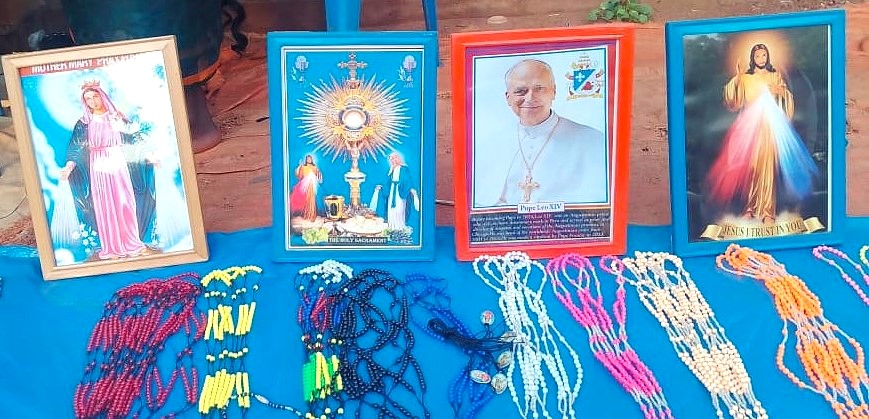
From the earliest centuries of Christianity, sacred paintings and sculptures have been much more than decorative works of art. They have served—and continue to serve—as visible expressions of the mysteries of faith, making divine realities more accessible to the faithful.
Every sacred image seeks to communicate profound theological truths.
The Catechism of the Catholic Church teaches:
“The sacred image, the liturgical icon, principally represents Christ… the incarnation of the Son of God has ushered in a new ‘economy’ of images” (CCC 1159).
It further teaches that:
“Christian iconography expresses in images the same Gospel message that Scripture communicates by words” (CCC 1160).
What Then Is the Meaning of the Prohibition in Exodus 20:4–5?
In this passage, God forbids Israel from making images for the purpose of worshipping them as gods. The prohibition is therefore directed against idolatry, not against sacred art itself.
Indeed, elsewhere in Exodus, God commands Moses to make two golden cherubim to stand upon the Ark of the Covenant (Exodus 25:18). Likewise, in Numbers 21:8, God instructs Moses to make the bronze serpent through which He brought healing to His people.
On the other hand, God strongly condemns the golden calf because the Israelites worshipped it as their god (Exodus 32:1–10).
Sacred images therefore become valuable when they lead us to contemplate God’s glory. They become sinful only when they replace God and become objects of worship.
Sacred Images and the Liturgy
The Church teaches that “all the signs in the liturgical celebrations are related to Christ” (CCC 1161).
Thus, even when sacred images of the Blessed Virgin Mary or the saints are displayed, they ultimately direct our attention to Christ, who is glorified in them.
Through these holy images, the faithful become more deeply aware of the “cloud of witnesses” who continue to accompany the Church and intercede for us, especially within the sacramental life of the Church.
Sacred Images and Church Tradition
It is the responsibility of the Church’s Magisterium to preserve both the written and unwritten traditions handed down through the centuries.
Representational sacred art forms part of this living tradition. It developed alongside the Church’s mission of evangelisation and bears witness to the reality of the Incarnation. Since the Son of God truly became man, His human image can legitimately be represented—not as an object of worship, but as a means of contemplation.
The earliest Christians, even during times of persecution, decorated the catacombs with symbolic images such as the Good Shepherd, the fish, and the anchor.
After Emperor Constantine granted religious freedom in the fourth century, Christian painting, mosaics, and sculpture flourished throughout the Church.
For this reason, the Church continues to encourage the use of sacred images in churches, homes, sacred vessels, vestments, and other places where they help the faithful contemplate the mysteries of salvation.
As the Catechism reminds us, through meditation upon sacred images, together with Sacred Scripture and the Church’s liturgy, the mysteries of our faith become deeply impressed upon our hearts and are reflected in our Christian lives (cf. CCC 1162).
Christian art remains an important source of prayer, inspiration, and catechesis.
At Uganda Martyrs Cathedral, Lira, for example, one finds numerous paintings, including beautiful stained-glass artwork created by Br. Vittorio Fanti, a Comboni missionary, at the request of Bishop Cesare Asili. These paintings—including scenes such as the Fall of Man, the Good Samaritan, and the Last Supper—continue to serve as valuable tools for catechesis. Indeed, as a catechumen in 1999, I vividly recall how our catechist used these very paintings to teach us the mysteries of our faith.
As we conclude this reflection on the various objects used as sacramentals, we are reminded that these sacred signs are intended to strengthen our faith, deepen our prayer, and lead us into a closer relationship with Christ. Their value lies not in the material from which they are made, but in the faith with which they are used and the grace of God to which they direct us.
As we continue journeying together through this series, feel free to send in any questions you may have regarding the teachings of the Church on the Sacraments and sacramentals for clarification in future reflections.
 English
 Arabic
 Chinese (Simplified)
 Dutch
 French
 German
 Italian
 Portuguese
 Russian
 Spanish