 English
 Arabic
 Chinese (Simplified)
 Dutch
 French
 German
 Italian
 Portuguese
 Russian
 Spanish

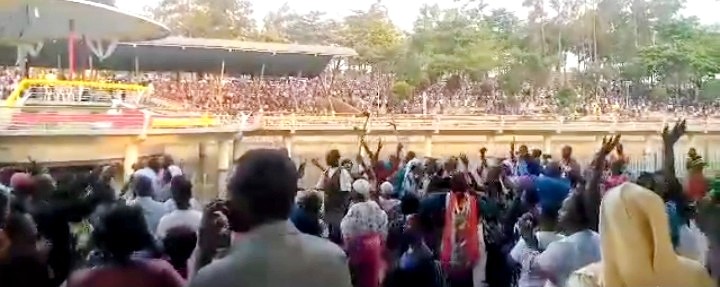
Closely related to exorcism, yet distinct in purpose and practice, the ministry of healing and deliverance reveals God’s desire to restore, renew, and set His people free. How does the Church understand and guide this important pastoral ministry?
By Fr. Constanz Opiyo, Secretary Commission of Doctrine
Healing and Deliverance Ministry
Closely related but different from exorcism is healing and deliverance ministry. While exorcism is a formal liturgical rite to expel demons from a possessed person, deliverance is a broader, less formal ministry aimed at freeing individuals from oppression, curses, or bondage. Healing focuses on emotional/mental restoration by addressing past wounds or family-tree related issues that have affected a person physically, psychologically and spiritually. Healing and deliverance ministry uses counselling and prayer to set a person free from demonic oppression, emotional or spiritual baggage.
The Catholic Charismatic Renewal has been at the forefront in this ministry offering to the faithful hope for wellness. Indeed, as the Congregation for the Doctrine of Faith states:
“The longing for happiness, deeply rooted in the human heart, has always been accompanied by a desire to be freed from illness and to be able to understand the meaning of sickness when it is experienced. This is a human phenomenon, which in some way concerns every person and finds particular resonance in the Church, where sickness is understood as a means of union with Christ and of spiritual purification. Moreover, for those who find themselves in the presence of a sick person, it is an occasion for the exercise of charity. But this is not all, because sickness, like other forms of human suffering, is a privileged moment for prayer, whether asking for grace, or for the ability to accept sickness in a spirit of faith and conformity to God’s will, or also for asking for healing” (Instruction on Prayers for Healing, 2000).
Church teaching on healing ministry
The Dicastery for the Doctrine of Faith published an instruction on prayers for healing in 2000. It draws from scripture and Church tradition the value and meaning of sickness and healing in the economy of salvation. It also gives disciplinary norms to follow in exercising the ministry.
Sickness and prayers for healing in the Bible
In the Old Testament, the experience of suffering especially sickness is linked to the mystery of sin and evil. Indeed even God sometimes threatened to punish the people of Israel with sickness due to their unfaithfulness (cf. Deuteronomy 28:21-22, 27-29, 35). The sick person who seeks God’s healing recognises and confesses to have been justly punished by God for his sins (Psalm 37, 40, 106:17-21).
However, the experience of the people of Israel also showed that sickness and suffering also strikes the just and they wondered why. This was a subject of reflection in the book of Job, who righteous though he was, suffered greatly. His suffering was interpreted as a test and confirmation of his righteousness.
Therefore sickness and suffering was viewed in the Old Testament as reparation for sin calling a sinner to repentance but also as a test for righteousness before God. Nevertheless, it still remained an evil. The prophets therefore announced a messianic time when there would be no more sickness and death (cf. Isaiah 35:5-6; 65:19-20)
In the New Testament, Jesus’ public activity was full of encounter with people who were sick seeking healing and deliverance from him. Jesus healed as many sick people as he encountered them. Matthew 9:35 says: “Jesus made a tour through all the towns and villages, teaching in their synagogues, proclaiming the good news of the kingdom and curing all kinds of disease and all kinds of illness.” These healings were signs of his messianic mission and manifested the victory of the Kingdom of God over every kind of evil. He gave authority to his disciples to heal the sick as he sent them out on mission (cf. Mt 10:1). He also told them that signs and wonders will accompany those who believe in him: “These are the signs that will be associated with believers: in my name they will cast out devils; they will have the gift of tongues; they will pick up snakes in their hands and be unharmed should they drink deadly poison; they will lay their hands on the sick, who will recover” (Mark 16:17).
Indeed, the Acts of Apostles recounts many signs and wonders among them the healing of the sick which accompanied the preaching of the apostles (Acts 2:43). The Christian community also prayed to God to accompany their preaching of the Word with signs and wonders. Many miracles were recorded to have been performed by the disciples (Philip, Paul, etc.)
At the same time, New Testament offers us insight on the Christian perspective of sickness and suffering. Christ conquered sickness not only by eliminating them through the miraculous healings but also by his innocent suffering and death. Christ suffered in order to alleviate our suffering. “By his wounds, you were healed” (1 Peter 2:24). Pope St. John Paul II says: “In the cross of Christ, not only is the redemption accomplished through suffering, but also human suffering itself has been redeemed… In bringing about the redemption through suffering, Christ has also raised human suffering to the level of redemption. Thus, each man in his suffering can also become a sharer in the redemptive suffering of Christ” (John Paul II, Apostolic Letter Salvifici Doloris, n. 19). Thus, we find in St. Paul a serene attitude of acceptance of suffering. Paul writes that he had asked the Lord three times to remove what tormented him but God’s response was, “My grace is enough for you: for power is at full stretch in weakness”. He took his suffering as a privilege to share in Christ’s own suffering for sake of the Church. “It makes me happy to be suffering for you now, and in my own body to make up all the hardships that still have to be undergone by Christ for the sake of his body, the Church (Colossian 1:24).
In the letter of St. James, we find prayers for healing raised to the level of a sacrament. “Any one of you who is ill should send for the elders of the church, and they must anoint the sick person with oil in the name of the Lord and pray over him. The prayer of faith will save the sick person and the Lord will raise him up again; and if he has committed any sins, he will be forgiven” (James 5:14-15).
From this biblical excursion, we get the following idea on sickness and suffering:
- Sickness is an evil that can be suffered as a consequence of sin and infidelity to God.
- It is also a test of fidelity of a righteous person
- People prayed for healing and deliverance from their sickness both in Old and New Testament and were healed.
- Jesus came to conquer the evil of sickness and healed many sick people who came to him.
- Jesus gave power to his disciples to heal the sick and promised that the charism of healing will continue in the Church as a sign to accompany the believers.
- We can bear sickness and with serenity if we join it to that of Christ in order to bear in our own flesh his continued suffering for the Church.
- The early Church developed a systematic practice in response to the desire for healing through the sacrament of anointing of the sick.
The charism of healing
From the early Church till today, the Church has continued with the ministry of healing. Many holy sites where Christians go for pilgrimages have been associated with healing such as Lourdes, the Sanctuary of St. Martin of Tours, the cathedral of St. James in Compostela, etc. Besides these, certain individuals have also had the charism of healing, that is, they are able to pray for the healing of a sick person and obtain the grace. St. Paul notes that the Holy Spirit distributes his gifts to whomever he chooses (1 Cor 12:11). Thus, even today, the gift of healing continues to be exercised.
The question then is not so much about the charism, but how it is exercised. As was mentioned above, healing and deliverance ministry should not only be focused on obtaining physical healing, but also the psychological and emotional wellness of a person. Many people suffer psychosomatic effects of unresolved psychological and emotional wounds such as trauma, addictions, etc. Sometimes also what a person needs is not physical healing, but the grace to accept in faith his/her suffering and join it with the suffering of Christ for his/her own salvation. Those who direct healing prayers should restrain from giving false hopes but always offer proper guidance that helps a sick person.
Some norms taken from the Instruction on Prayers for Healing, 2000 – Dicastery for the Doctrine of Fatih
Desire for healing
- It is licit for every member of the faithful to pray to God for healing. When this is organized in a church or other sacred place, it is appropriate that such prayers be led by an ordained minister (Art. 1).
Liturgical prayers for healing
- Prayers for healing are considered to be liturgical if they are part of the liturgical books approved by the Church’s competent authority; otherwise, they are non-liturgical (Art. 2).
- Liturgical prayers for healing are celebrated according to the rite prescribed in the Ordo benedictionis infirmorum of the Rituale Romanum (28) and with the proper sacred vestments indicated therein (Art. 3 “ § 1.).
- The Diocesan Bishop has the right to issue norms for his particular Church regarding liturgical services of healing, following canon 838 § 4 (Art. 4 § 1.).
- Those who prepare liturgical services of healing must follow these norms in the celebration of such services (Art. 4 § 2).
- Permission to hold such services must be explicitly given, even if they are organized by Bishops or Cardinals, or include such as participants. Given a just and proportionate reason, the Diocesan Bishop has the right to forbid even the participation of an individual Bishop (Art. 4 § 3).
Non-liturgical prayers for healing
- Non-liturgical prayers for healing are distinct from liturgical celebrations. They are prayer meetings where the Word of God is read and shared and prayers for healing are offered without a liturgical rite. This too falls under the vigilance of the local Ordinary in accordance with canon 839 § 2 (Art. 5 § 1).
- Confusion between such free non-liturgical prayer meetings and liturgical celebrations properly so-called must be avoided (Art. 5 § 2).
- Anything resembling hysteria, artificiality, theatricality or sensationalism, above all on the part of those who are in charge of such gatherings, must not take place (Art. 5 § 3).
- The use of means of communication (social media) in connection with prayers for healing, falls under the vigilance of the Diocesan Bishop ( Art. 6).
Prayers for healing and Mass
- Prayers for healing whether liturgical or non-liturgical must not be introduced into the celebration of the Holy Mass, the sacraments, or the Liturgy of the Hours (Art. 7 § 1).
Prudence in directing prayers meetings for healing
- Those who direct healing services, whether liturgical or non-liturgical, are to strive to maintain a climate of peaceful devotion in the assembly and to exercise the necessary prudence if healings should take place among those present; when the celebration is over, any testimony can be collected with honesty and accuracy, and submitted to the proper ecclesiastical authority (Art. 9).
- Authoritative intervention by the Diocesan Bishop is proper and necessary when abuses are verified in liturgical or non-liturgical healing services, or when there is obvious scandal among the community of the faithful, or when there is a serious lack of observance of liturgical or disciplinary norms (Art. 10).
Send in your questions for more clarification
End