en English
ar Arabiczh-CN Chinese (Simplified)nl Dutchen Englishfr Frenchde Germanit Italianpt Portugueseru Russianes Spanish

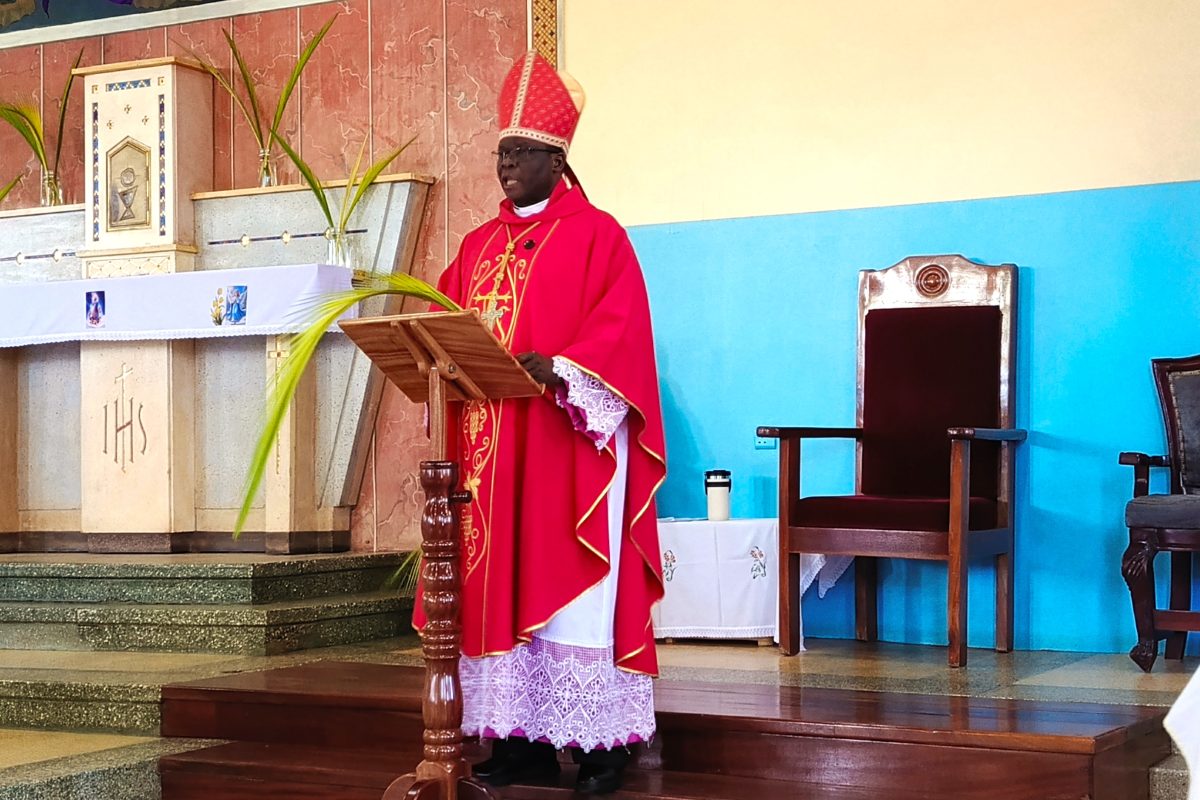
Bishop Wanok Calls for Faith, Unity, and Renewal in Palm Sunday Message to Lira Diocese

In his Palm Sunday message, the bishop reflected on the dual nature of the day’s liturgy, Jesus’ triumphant entry into Jerusalem and the solemn reading of His Passion. He emphasized that true Christian discipleship involves not only moments of celebration but also walking with Christ through suffering and the Cross.
By Fr. Isaac Ojok, Communications Office, Lira Diocese

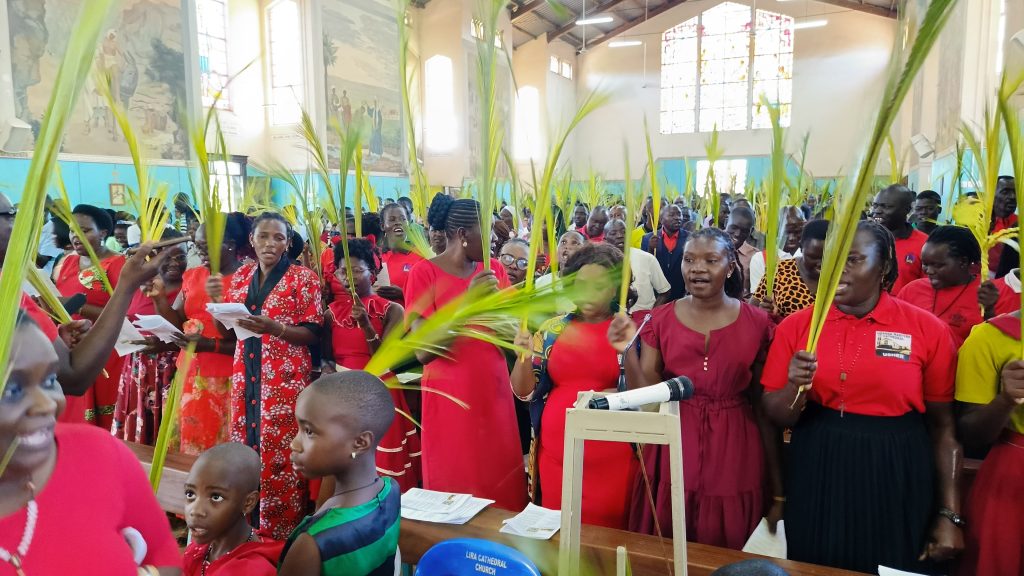
As Christians across the world marked Palm Sunday, on 29th March 2026, the beginning of Holy Week, thr Rt. Rev. Sanctus Lino Wanok, the of Lira diocese delivered a heartfelt homily to the faithful of Lira Diocese and listeners of Radio WA, urging them to embrace both the joy and sacrifice at the heart of the Christian journey.

In his Palm Sunday message, the bishop reflected on the dual nature of the day’s liturgy, Jesus’ triumphant entry into Jerusalem and the solemn reading of His Passion. He emphasized that true Christian discipleship involves not only moments of celebration but also walking with Christ through suffering and the Cross.

Highlighting the humility of Jesus, who entered Jerusalem riding on a donkey rather than in royal splendor, Bishop Wanok described Him as “a different kind of king

the king who serves, saves, and gives his life for his people.” He challenged believers to reflect personally on their relationship with Christ, asking, “Who is Jesus in your life?”

Drawing from Scripture, the bishop connected the Suffering Servant in Isaiah, the lament of the Psalms, and Saint Paul’s teaching on Christ’s self-emptying love to illustrate the depth of Jesus’ sacrifice. He reminded the faithful that Christ understands human suffering and remains close to those experiencing hardship, poverty, and discouragement.

Bishop Wanok also spoke about the importance of humility, service, and communal unity, especially within what he described as a “synodal Church”, a Church that walks together. He encouraged Christians to support one another, listen deeply, and carry each other’s burdens during this sacred season.

Reflecting on the Passion narrative, he noted the different human responses to Jesus, from betrayal and denial to faithfulness and courage. He urged believers to use Holy Week as a time for personal reflection, repentance, and renewal.

Recalling his recent visit to Rome for the ad limina apostolorum, the bishop shared how praying at the tombs of Saints Peter and Paul inspired hope, noting that even in human weakness, God’s grace leads to transformation and strength.

He concluded by encouraging practical actions during Holy Week: fostering forgiveness within families, participating in liturgical celebrations, caring for the poor and vulnerable, and seeking reconciliation with God.

“Palm Sunday reminds us that carrying palms is only the beginning,” Bishop Wanok said. “We are called to walk with Christ through the entire journey, toward the Cross and ultimately the joy of the Resurrection.”

The bishop ended his message with a prayer for families, youth, clergy, and the wider Church, asking for renewed faith, unity, and strength during Holy Week.

 End

Bishop Wanok Returns from Ad Limina Apostolorum Visit to Rome

By Flavia Oyuu, Communications Office

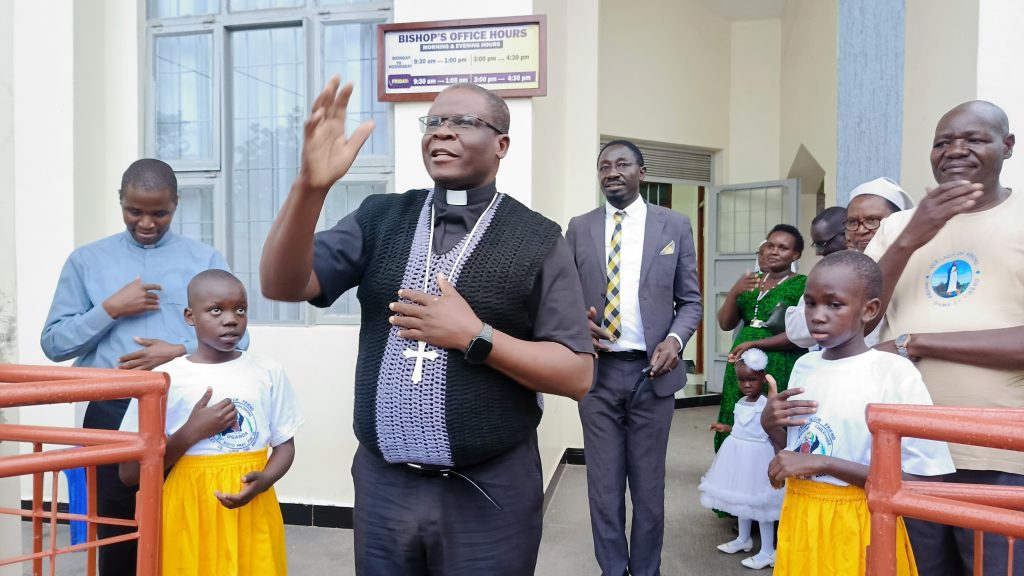
The Bishop of Lira Diocese, Rt. Rev. Sanctus Lino Wanok, on Saturday evening returned to Uganda Martyrs Cathedral in Lira after a week-long Ad Limina Apostolorum visit to Rome.

Bishop Wanok arrived at the cathedral a few minutes past 6:00 p.m. and was received by a joyful crowd of pupils from St. Kizito Primary School accompanied by their school band.

In his welcome remarks, the Vicar General of Lira Diocese, Msgr. Innocent Valente Opio, said it gladdened the hearts of the faithful to receive “the father of the home” after two weeks of his absence from the diocese.

He thanked the Bishop for representing the people of Lira Diocese well before the Holy Father during the visit.

Msgr. Opio added that due to the ongoing war in the Middle East, Christians in the diocese had been praying for the Bishop to travel safely to Rome and return home without difficulty.

He also assured the Bishop that the diocese remained stable during his absence, noting that only a few minor challenges had occurred. Among them, he mentioned that Msgr. Polycarp Opio, the Vicar for the Clergy, had recently lost his uncle.

Speaking after the welcome, Bishop Wanok expressed gratitude to the faithful for the warm reception and for keeping him in prayer throughout his journey.

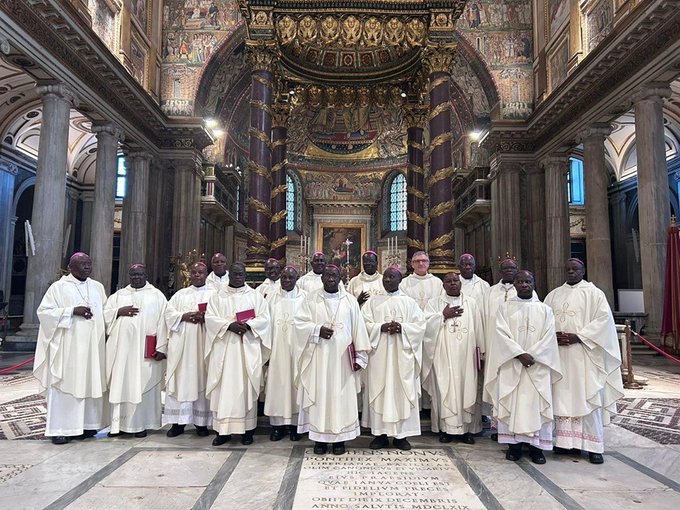
The Bishop shared that the visit to Rome had been both spiritually enriching and demanding, involving meetings with various Vatican offices as well as a personal audience with the Holy Father together with other bishops.

He said the Pope showed great concern about the wellbeing of Christians in their dioceses and encouraged the bishops to continue strengthening the faith of their people. According to Bishop Wanok, the Holy Father expressed joy that Uganda remains one of the strongest countries in Africa in matters of faith, largely because of the witness of the Uganda Martyrs.

The Bishop also noted that during the meetings, the bishops shared reports on different aspects of Church life, including education, health services, charitable work through Caritas and the general pastoral mission of the Church.

While in Rome, the bishops also visited important pilgrimage sites, including the tombs of the Apostles Peter and Paul, where they prayed for the Church, the clergy, religious and the faithful back home.

Bishop Wanok said he remained in Rome briefly after the official meetings to make a personal retreat, during which he spent time in prayer for the people of Lira Diocese, the country and all those who had asked for his prayers.

He concluded by thanking the Christian community for their unity and commitment to supporting the mission of the Church in the diocese.

End

Bishop Wanok Urges Renewal and Unity During Ad Limina Visit in Rome

By Fr Isaac Ojok, Communications Office, Lira Diocese

The Bishop of Lira Diocese, Rt. Rev. Sanctus Lino Wanok, has called on the faithful to embrace spiritual renewal, unity, and practical Christian living during this Lenten season.

Delivering his homily from Vatican City, Rome, where he is participating in the Ad Limina visit of Catholic Bishops from Uganda, Bishop Wanok reflected on the message of the Fifth Sunday of Lent, emphasizing that the Word of God speaks directly to the realities faced by Christians in Lango subregion.

He highlighted key challenges affecting communities, including family conflicts, poverty, youth unemployment, weakening faith, and divisions within society and Church groups. Despite these difficulties, the Bishop reassured the faithful of God’s promise of new life and restoration.

Drawing from the Gospel account of the raising of Lazarus, Bishop Wanok underscored the importance of listening, collaboration, and shared responsibility within the Church. He encouraged Christians to become a listening community, to work together in overcoming challenges, and to actively support one another in faith.

The Bishop also called on individuals to reflect on personal and communal obstacles such as unforgiveness, division, corruption, and lack of active participation in Church life, urging them to take concrete steps toward change.

He emphasized that true renewal in Lira Diocese will come through a deeper relationship with God and openness to the Holy Spirit, rather than plans alone.

As part of his Lenten message, Bishop Wanok proposed three key actions for the faithful: deepening prayer life, strengthening Small Christian Communities, and taking practical steps to reconcile, support the needy, and guide the youth.

He concluded by encouraging hope and faith among the faithful, reminding them that God continues to call His people to new life.

The Bishop delivered his homily during the ongoing Ad Limina visit, a significant moment of prayer and reflection for bishops in communion with the universal Church, in the Vatican City, Rome. 

End

Understanding Sacramentals in the Life of the Church

Commission of Doctrine – Lira Diocese
By Fr. Constanz Opiyo, MCCJ

Introduction

The Commission of Doctrine warmly welcomes esteemed readers of our diocesan website to a series of reflections on topical issues concerning the faith and morals of the People of God in Lira Diocese. We begin with the theme of sacramentals. This week we shall introduce the topic. Your questions will enrich our discussions; therefore, we invite you to read, make comments, and give your questions. We shall try to respond as promptly and exhaustively as we can.

Sacramentals

What are Sacramentals?

Sacramentals “are sacred signs which bear a resemblance to the sacraments. They signify effects, particularly of a spiritual nature, which are obtained through the intercession of the Church. By them, men are disposed to receive the chief effect of the sacraments, and various occasions in life are rendered holy” (Catechism of the Catholic Church, CCC 1667).

They can also be objects or actions instituted by the Church to sanctify the faithful daily. They resemble the sacraments and prepare the faithful to receive grace through the sacraments. Sacramentals help to sanctify various circumstances of life, protect against evil, and foster devotion. Every sacramental involves prayer accompanied by a specific sign like the sign of the cross or sprinkling with holy water.

Examples/Categories of Sacramentals

  • Blessings: given to people, meals, homes, machines, religious objects, etc.
  • Prayers: of exorcism, healing, and deliverance, etc.
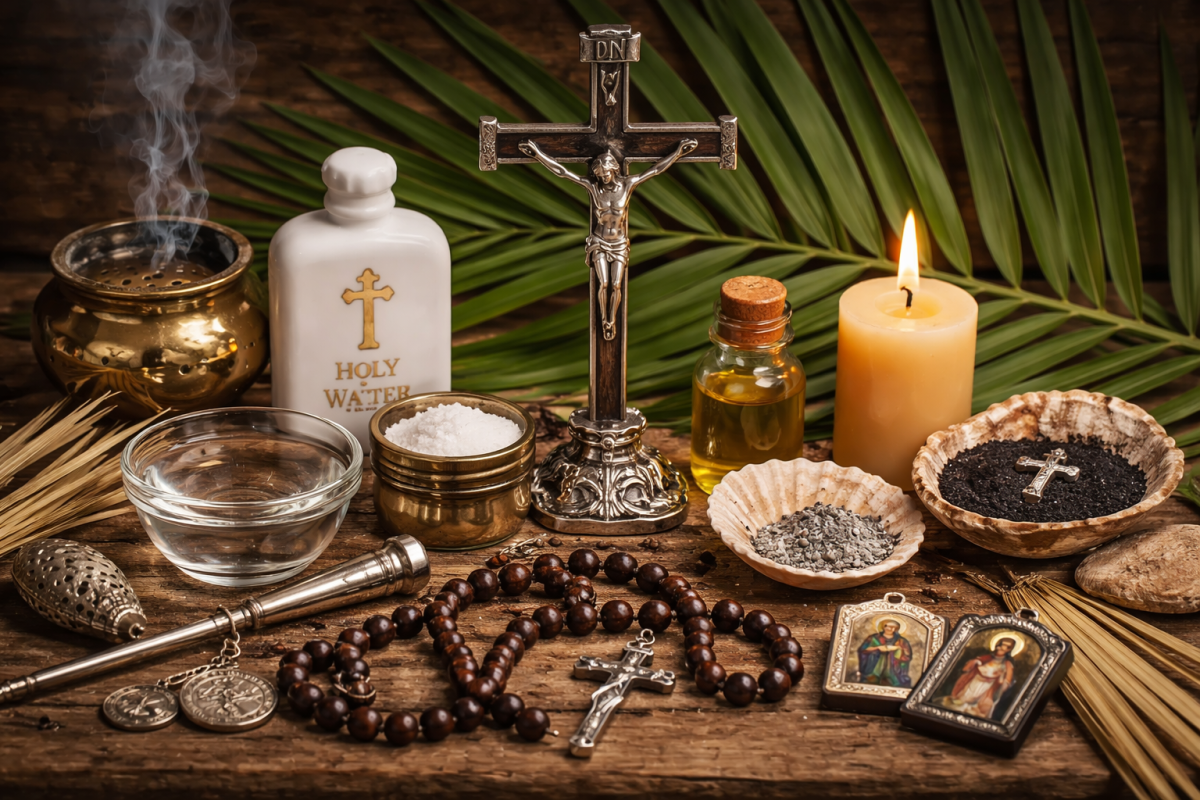
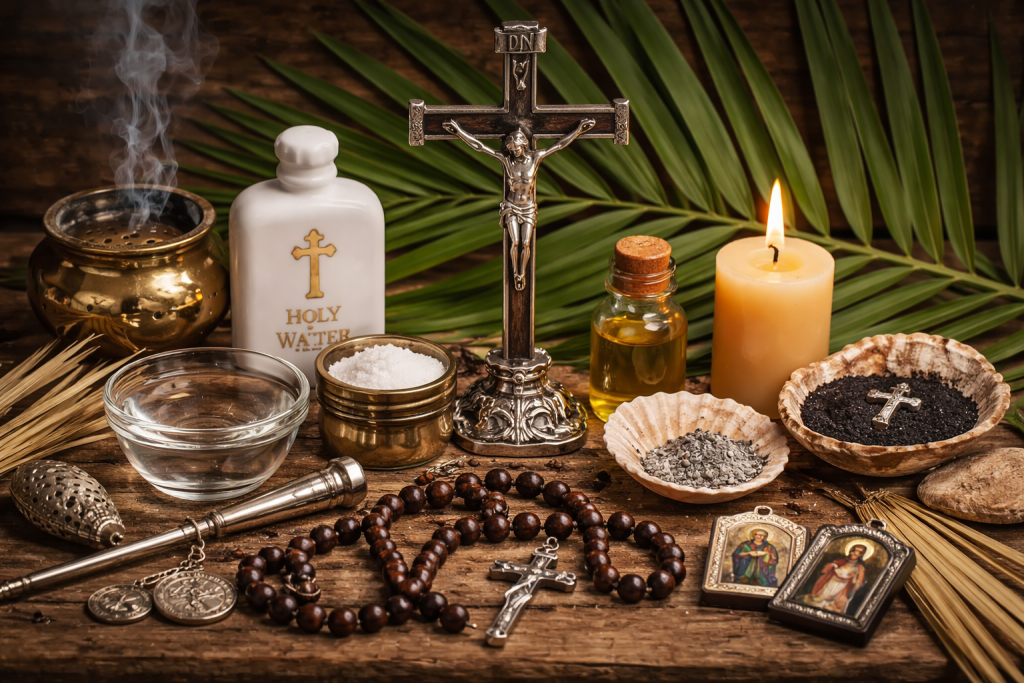
  • Objects: holy water, crucifixes, rosaries, medals, candles, ashes, palms, etc.
  • Actions/Devotions: the sign of the cross, stations of the cross, pilgrimages, exorcism, healing and deliverance, etc.

What is the Difference Between Sacraments and Sacramentals?

Sacraments

Sacraments are visible and efficacious signs of grace instituted by Christ through which God communicates his divine life to us. There are seven sacraments of the Church:

  1. Sacraments of Christian initiation: Baptism, Confirmation, Eucharist
  2. Sacraments of healing: Penance and Anointing of the Sick
  3. Sacraments at the service of communion: Holy Orders and Matrimony

Sacraments are necessary for salvation. Without them, we are deprived of the grace of God that enables us to attain salvation. For example, without baptism, one cannot be called a Christian nor enter the kingdom of God. In John 3:5, Jesus states clearly:

“In all truth I tell you, no one can enter the kingdom of God without being born through water and the Spirit.” By water and spirit is implied the sacraments of baptism and confirmation. Regarding the Eucharist, Jesus says: “In all truth I tell you, if you do not eat of the flesh of the Son of man and drink his blood, you have no life in you” (John 6:53).

Sacraments are absolutely necessary for our salvation and they operate in such a way that the grace conferred by each sacrament is received as it is being administered, provided the conditions for its valid celebration are met. It is termed in Latin as ex opere operato.

Sacramentals

Sacramentals, on the contrary, depend on the faith of the user and the intercession of the Church. They are meant to foster devotion but do not replace the sacraments themselves. While they may be very important because through them we are sanctified or receive graces we need to live in a manner worthy of our Christian calling, they are not absolutely necessary for our salvation.

Examples:

  • When we eat, we begin by blessing the food, recognizing it as a gift from God and at the same time asking Him to make us receive from it the energy we need to work to earn our living. We also recognize in the simple meal a foretaste of the heavenly banquet.
  • When we sprinkle blessed water at home to bless the house and those living in it, we do it by faith that God may bless us and make our home His dwelling place.

By sprinkling the house with blessed water, we show faith in God who came to dwell among us in His Son Jesus Christ.

The Danger of Superstition

However, when we use sacramentals as though they had power in themselves, we have passed from faith to superstition. For example, when water is sprinkled at home without faith, it does not bring the desired effect; God does not come to dwell in that home. Instead, the act becomes devoid of meaning and more of a superstition.

What is Superstition?

Superstition is when one sees an object as having power in itself, not as a sign. Superstition is when we believe that certain objects have power in themselves and we use them not out of faith in God but out of our belief that the object possesses its own power capable of bringing the desired effect.

The use of sacramentals should never degenerate into superstition. There are objects we use such as water, salt, oil, incense, etc. They are used by faith and through the intercession of the Church to sanctify our lives daily, but not because of any power they have of their own. When we think salt has power in itself, then it is superstition.

Some Possible Questions That May Arise

Question 1:

What about our grandparents and ancestors who died without receiving baptism or any other sacrament? Are they condemned to hell fire?

Response:

Luke 12:47-48 states:

“The servant who knows what his master wants, but has got nothing ready and done nothing in accord with those wishes, will be given a great many strokes of the lash. The one who did not know, but has acted in such a way that deserves a beating, will be given fewer strokes. When someone is given a great deal, a great deal will be demanded of that person; when someone is entrusted with a great deal, of that person more will be expected.”

Jesus tells us that the person who does not know even if he has acted wrongly cannot suffer the same magnitude of punishment as the one who knows. Our ancestors lived at a time when they did not know God as revealed by Jesus Christ, yet even in their traditional religion, they sought to know God and to serve Him. Every people and culture had their own approach to religion and morality. Concepts of good and evil are universal and are known beyond the confines of Christianity.

Therefore, our ancestors who lived good moral lives do in fact share the glory of heaven, because they sought to know God, serve Him, and live in a worthy manner. However, those ancestors who were wicked suffer the consequence of their actions. Their punishment may not be as severe as for those who have been enlightened by the Gospel of Christ. This is the reason why we pray for the souls in purgatory. For us today who have received the Gospel, we cannot excuse ourselves. We need the sacraments for our salvation.

Question 2:

How do I know if I am using a sacramental according to the faith of the Church and not acting in a superstitious manner?

Response:

In Acts 8:9-24, we find information on a certain man called Simon the magician. He was baptized and became a Christian by the deacon Philip, but he did not abandon his former life of witchcraft. He tried to bribe Peter and John when he saw them praying over the people to receive the Holy Spirit. He thought Peter and John had the power to give the Holy Spirit to people they laid their hands on and that he could pay them to give him some of their power to do the same.

Simon needed the power so that he could make money from his magic performances. Simon did not recognize that the power or authority to give the Holy Spirit comes from God and not from the apostles themselves. This is exactly what we call superstition.

When we think we have power in ourselves to lay hands on others so that they are healed or receive some grace, we become magicians. It is God who gives the power and authority. The authority does not come from us.

Similarly, when we think an object like salt has power in itself and not as a sign of God’s grace working through the blessed object, we are acting in a superstitious way. For example, if I sprinkle salt around the house thinking that the salt will protect my house instead of God Himself, I am acting in a superstitious manner.

Psalm 127:1 says:

“If Yahweh does not build the house, in vain do its builders toil. If Yahweh does not guard the city, in vain does its guard keep watch.”

It is clear therefore that the power comes from God and not from us. Sacramentals are used with faith in God who acts through these visible signs to bring to us His blessings, protection, and divine life.

Add Your Questions to Enrich the Topic

Readers are invited to submit their questions, which will enrich the discussion.

Next Topic

First Category of Sacramentals: Blessings

Fr. Constanz Opiyo, MCCJ
Secretary, Doctrinal Commission
Lira Diocese

St. Joseph’s Minor Seminary Aboke Marks Feast Day with Call for Deeper Formation and Commitment

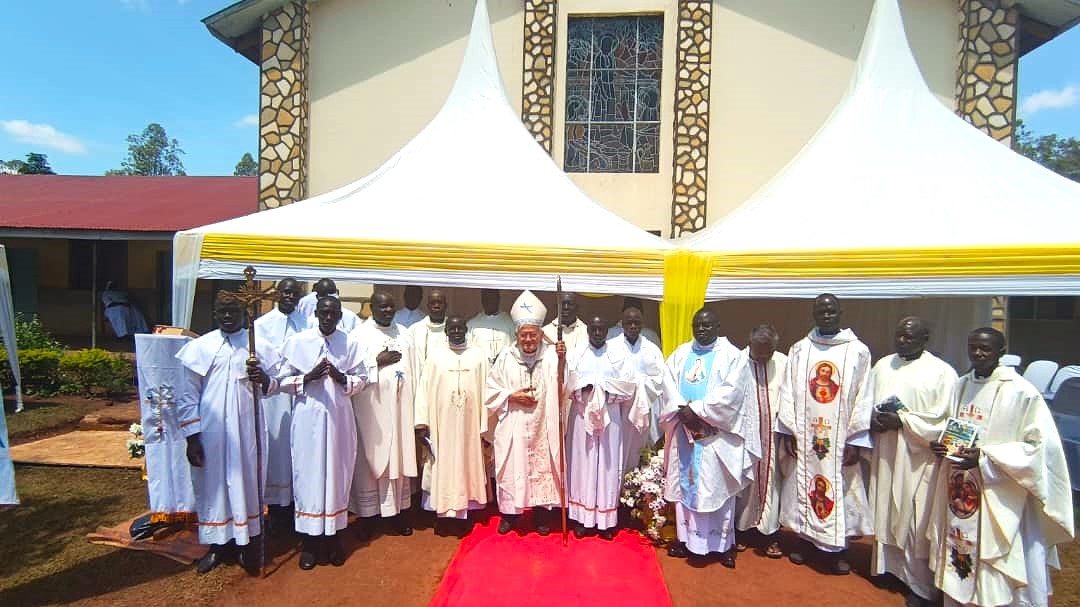
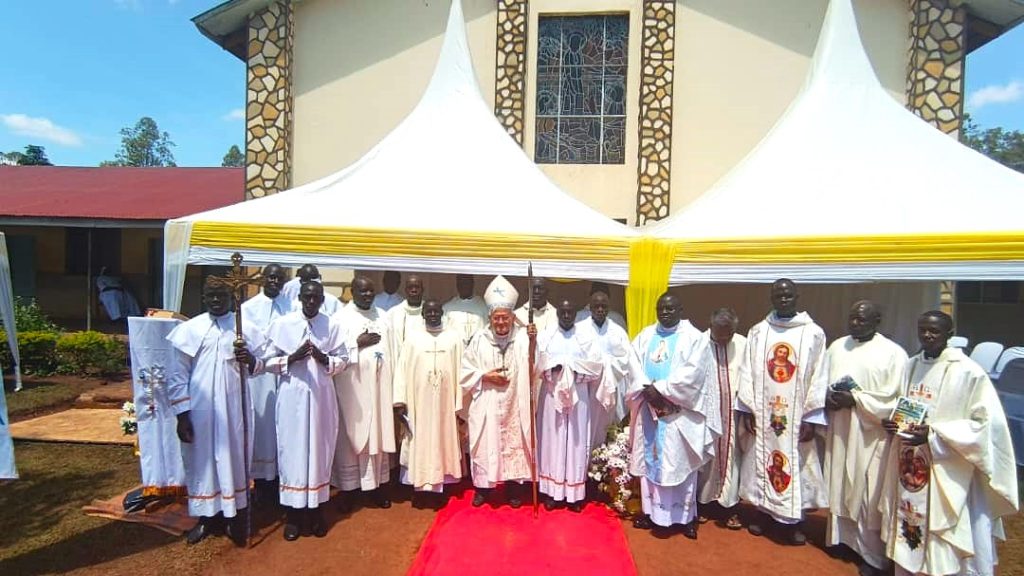
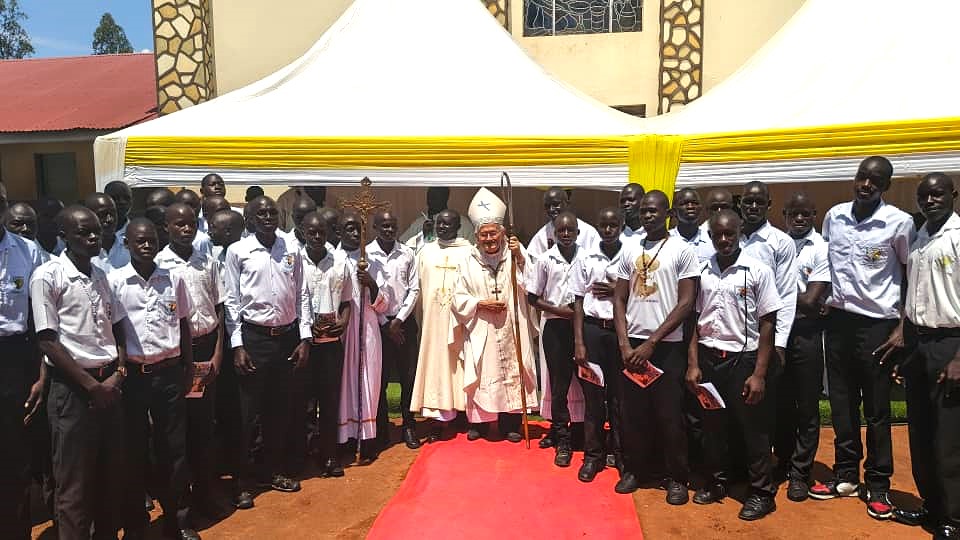
The celebration was highlighted by a solemn Holy Mass led by the Rt. Rev. Joseph Franzelli, Bishop Emeritus of Lira Diocese. The occasion brought together priests, diocesan authorities, civil leaders, neighboring institutions, and the seminary administration in a unified celebration of the patron saint.

By Fr. Isaac Ojok, Communications Office, Lira Diocese

St. Joseph’s Minor Seminary Aboke on March 19, 2026, joined the universal Church in celebrating the Feast of Saint Joseph, in a vibrant event marked by prayer, reflection, and community participation.

The celebration was highlighted by a solemn Holy Mass led by the Rt. Rev. Joseph Franzelli, Bishop Emeritus of Lira Diocese. The occasion brought together priests, diocesan authorities, civil leaders, neighboring institutions, and the seminary administration in a unified celebration of the patron saint.

The Bishop Emeritus was accompanied by several dignitaries, including Monsignor Valente Innocent Opio, the Vicar General of Lira Diocese, Monsignor Polycarp Opio, the Vicar for Clergy Lira diocese and other heads of department in the diocese.

Homily Emphasizes Holistic Formation

During the Eucharistic celebration, Bishop Franzelli began his homily by reflecting on the biography, genealogy, and virtues of St. Joseph, presenting him as a model of humility, obedience, and silent strength.

He challenged the teaching community to prioritize effective formation, emphasizing that true formation goes beyond words and theoretical instruction.

“Effective formation is not done only through nice words and theories, but through the example of life, collaboration, and unity among formators,” he noted.

The Bishop further observed that serving in a seminary requires sacrifice and self-denial.

“You may miss the advantages and financial support that your fellow priests in parishes receive,” he said, urging formators to remain committed to their mission without seeking more rewarding assignments.

He also encouraged them to remain close to seminarians, especially those facing challenges in the formation process.

He also encouraged them to remain close to seminarians, especially those facing challenges in the formation process.

“Looking at you, these young boys should understand what a good priest is supposed to be,” he added.

Message to Seminarians

Addressing the seminarians, Bishop Franzelli urged them to fully embrace their formation journey and not take for granted the sacrifices made by their parents and guardians.

He emphasized responsibility, encouraging students to take care of seminary property, including buildings and the compound.

The Bishop also highlighted the importance of manual work, describing it as a vital part of personal growth. He further encouraged seminarians to develop self-awareness, understand their strengths and weaknesses, and grow into mature and responsible individuals.

In addition, he called on them to nurture their spiritual lives by cultivating a personal relationship with Jesus Christ through prayer.

Church Communication Developments 

In his closing remarks, the Bishop pointed to significant developments in Church communication, noting the existence of several diocesan radio stations and the network of Radio Maria stations across Uganda.

He also highlighted the recent launch of Uganda Catholic Television, adding that a new studio is under development in Lira. He revealed that the first interview has already been conducted with Bishop Wanok about his Ad Limina visit to Rome.

The Bishop appealed for continued financial support towards Church media initiatives, particularly local radio stations.

Community Support and Contributions

The feast day also served as an opportunity for the Old Boys Association, individuals, institutions, and Catholic parishes to mobilize resources to support the seminary’s operations.

Speaking on behalf of the Old Boys, Mr. Joseph Jolly Oyom expressed gratitude to the seminary administration for their dedication and commitment to formation.

He encouraged parents to pay school fees on time to facilitate smooth learning and formation programs. He also highlighted ongoing development projects, including the construction of a library initiated by the Old Students Association (JoSOBA).

Seminary Status and Future Activities

In his remarks, the Rector, Fr. Deogracious Odwe, revealed that the seminary currently has 43 teaching and non-teaching staff and 160 students at both O-Level and A-Level.

He expressed appreciation to all supporters, especially those contributing financially to the institution’s growth and sustainability.

Fr. Odwe also announced that the celebrations would continue with a football tournament organized by the Old Boys Association, scheduled to run from Friday through Saturday.

Call for Continued Support 

Monsignor Valente Innocent Opio, who also serves as the Chairperson of the Board of Governors, thanked all well-wishers for their continued support.

“I beg you, do your best so that the seminary runs,” he appealed, acknowledging the financial challenges faced by many families.

He also noted the introduction of additional aspects of formation within the seminary, including media and accountability, stressing that seminarians must learn effective communication skills.

A Legacy of Impact

St. Joseph’s Minor Seminary Aboke continues to be a vital center for the formation of young men, producing numerous priests serving within and beyond Lira Diocese. Among its distinguished alumni is the Bishop of Arua Diocese, Rt. Rev. Sabino Ochan Odoki. 

The institution has also shaped many individuals who, though not ordained as priests, have gone on to become influential members of society. These alumni remain deeply appreciative of the values and discipline instilled in them during their time at the seminary.

End