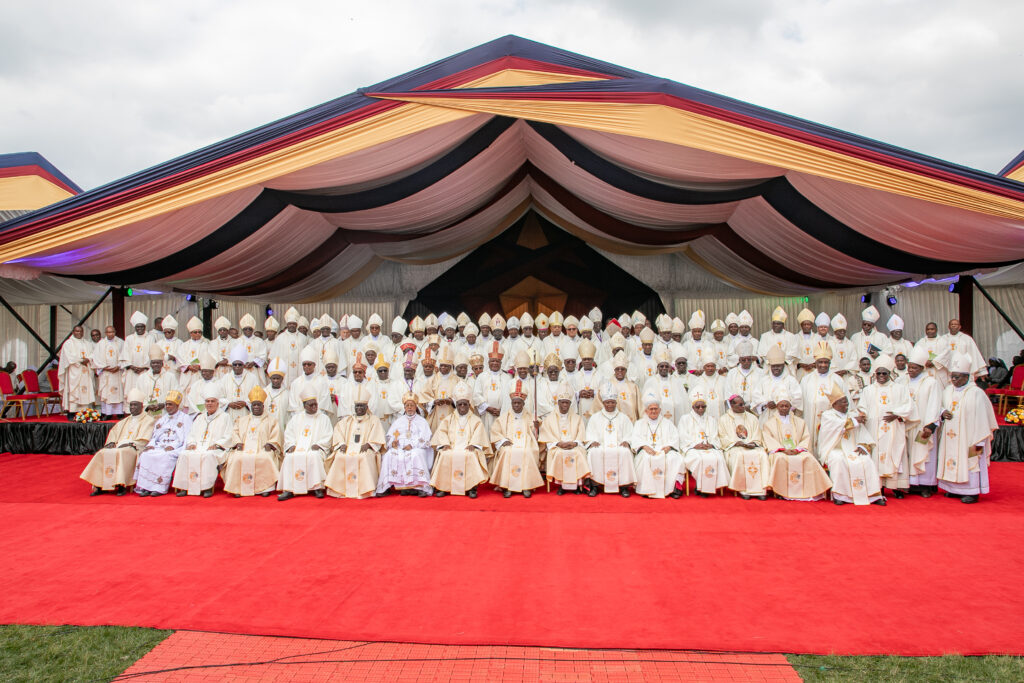
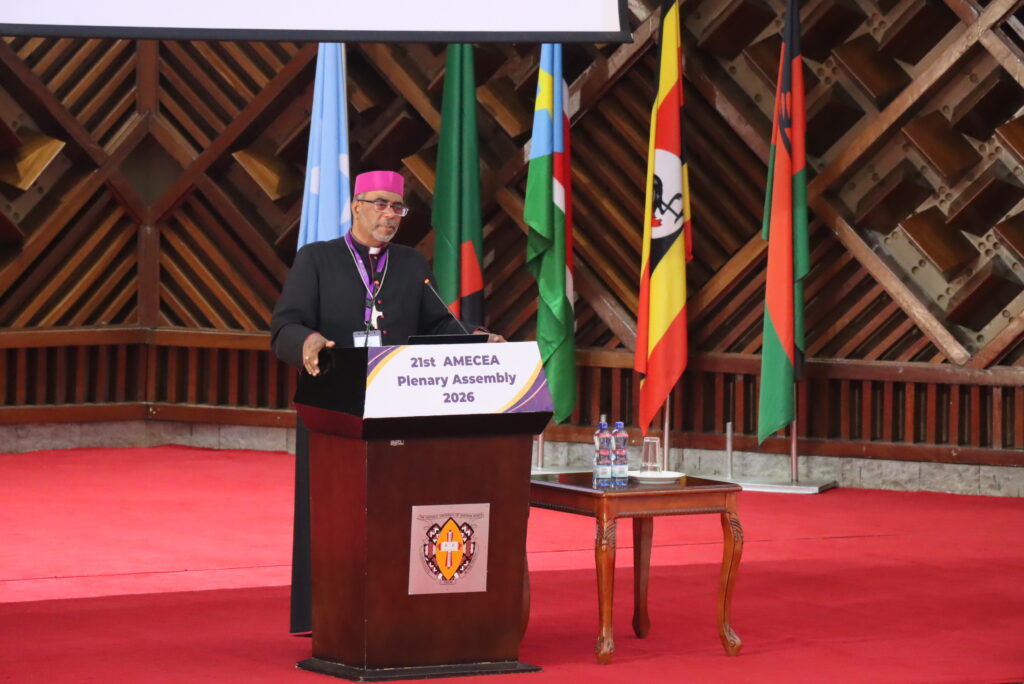
At the closing Mass of the 21st Plenary Assembly of the Association of Member Episcopal Conferences in Eastern Africa (AMECEA) on Sunday, July 26, the bishops resolved to listen to and walk with the young people in the region over the next four years.
“We love you, we believe in you, and we invite you to participate fully in the life and mission of the Church and in the life of your respective countries,” Bishop Martin Mtumbuka of Karonga Diocese, Malawi, read the communiqué issued at the end of the week-long plenary.
In his message on behalf of the Bishops, more than 15,000 young people from Kenya and across the region animated the opening Eucharistic celebration, filling the compound of the Catholic University of Eastern Africa (CUEA) with song.
The voice of the young people, the bishops noted, was a clarion call to Church leaders, parents and other stakeholders to create more time and space for youth participation in leadership and decision-making. The young delegates also turned the challenge on themselves, committing to remain open to learning, discerning and embracing emerging opportunities.
The bishops pointed out that the youth are God’s children who need understanding, accompaniment, deeper catechesis and holistic formation, grounded in Catholic Social Teaching and attentive to the signs of the times.
In their resolutions, the bishops committed to strengthening pastoral accompaniment and youth chaplaincies, and to deepening catechesis and faith formation explicitly including responsible engagement with Artificial Intelligence (AI), social media and other emerging digital technology. They resolved to form Catholic digital missionaries for evangelization in the digital age.
Besides, the Small Christian Communities (SCCs), which are the backbone of Church life in Eastern Africa, are to be revitalized as spaces of healing and belonging, with hybrid online communities being part of the model. The family is to be supported as the first school of faith and identity.
In their response to young people, the Church leaders said mental health and psycho-social support and services are to be expanded. Safeguarding policies, formation and youth-led accountability are also to be strengthened, with young people themselves at the forefront.
On governance, the bishops pledged to promote transparent leadership and youth co-responsibility in both Church and civic life, including creating and strengthening dedicated youth desks. While on livelihoods, they committed to investing in education, mentorship, entrepreneurship and skills development, as they resolve to deepen the shared regional spirit of collaboration and solidarity among member Conferences.
The assembly also resolved to advocate for the safe and lawful free movement of citizens within the region, to address the root causes of forced migration, and to support policies protecting migrants and refugees across the AMECEA region.
Reminding the people of God of the message from His Eminence Michael Cardinal Czerny, Prefect of the Dicastery for Promoting Integral Human Development, Bishop Mtumbuka read that the Cardinal urged young people to embrace dialogue as an essential ingredient for fostering love, unity and peace, and for restoring trust among people and nations.
According to the Sunday communiqué, young people are not asked to wait for the Church to act on their behalf; but they are asked to sit in the rooms where decisions are made on youth desks, in accountability structures, inside the safeguarding mechanisms meant to protect young people.
By Fr. Constanz Opiyo Commission of Doctrine, Lira Diocese
Dear readers,
As we continue our journey through this series on sacramentals in the life of the Church, we now turn our attention to some of the other objects commonly used in Catholic worship and private devotion. Many of these are familiar to us and are frequently seen in our churches and homes. Understanding their meaning helps us to appreciate them not merely as religious objects but as signs that deepen our faith and draw us closer to God.
In this reflection, we conclude our discussion on some of the most common objects used either in the Church’s public liturgy or in private devotional life.
1. Incense
Incense has always occupied an important place in the worship of God, as we read in Sacred Scripture. In Exodus 30:34–37, God instructs Moses to prepare incense specifically for divine worship and forbids its manufacture for ordinary personal use, declaring it to be “holy, reserved for the Lord.”
In the Catholic liturgy, following this biblical tradition, incense symbolizes sanctification, purification, and the prayers of the faithful rising to God, as expressed in Psalm 141:2 and Revelation 5:8.
Incense is used during solemn celebrations of the Holy Mass, funerals, processions, and Eucharistic Adoration. During the liturgy, it honours Christ, who is the principal actor in every celebration: Christ present in the priest acting in persona Christi, Christ present in the gathered assembly who form His Mystical Body, and Christ present upon the altar where the sacrifice of Calvary is made sacramentally present.
The rising smoke symbolizes the prayers of the faithful ascending to heaven, while its fragrance signifies the presence of God and the pleasing aroma of Christ.
During Mass, incense is ordinarily used during the Entrance Procession, the proclamation of the Gospel, the Preparation of the Gifts, and the elevation of the Sacred Species during the Eucharistic Prayer.
The incense grains are kept in a small container called the boat, while burning charcoal is placed in a thurible (censer). The priest blesses the incense before placing it on the burning charcoal for use during the liturgy.
Whenever incense is used, it reminds us that we are standing in a sacred place and in the presence of God.
Incense intended for liturgical worship should not be taken home for private devotional use outside the liturgical celebration.
2. Crucifix
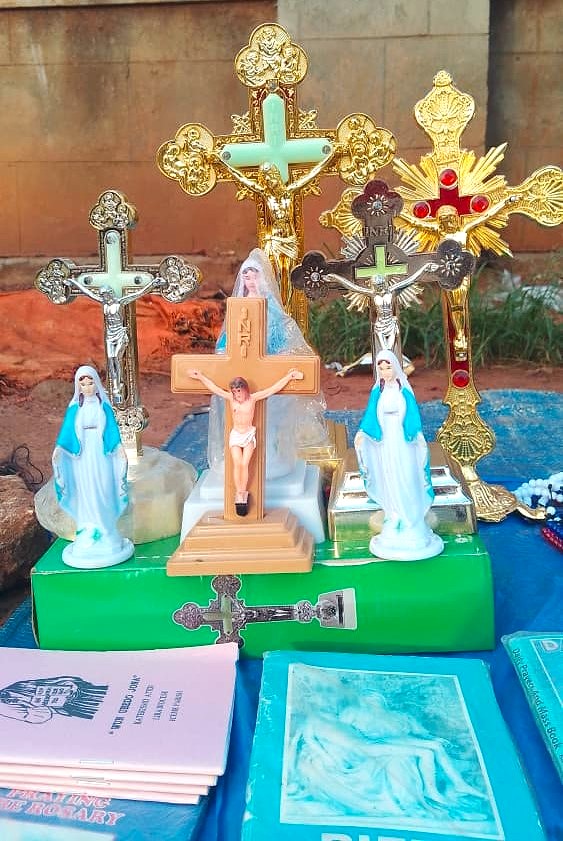
A crucifix is the representation of Christ crucified upon the Cross for the salvation of humanity.
It is a commendable Christian devotion to wear a crucifix or to display one in the home. It serves as a constant reminder of Christ’s supreme sacrifice through which our salvation was won.
A crucifix intended for devotional use should be blessed by an ordained minister before being used.
3. Rosaries, Medals and Scapulars
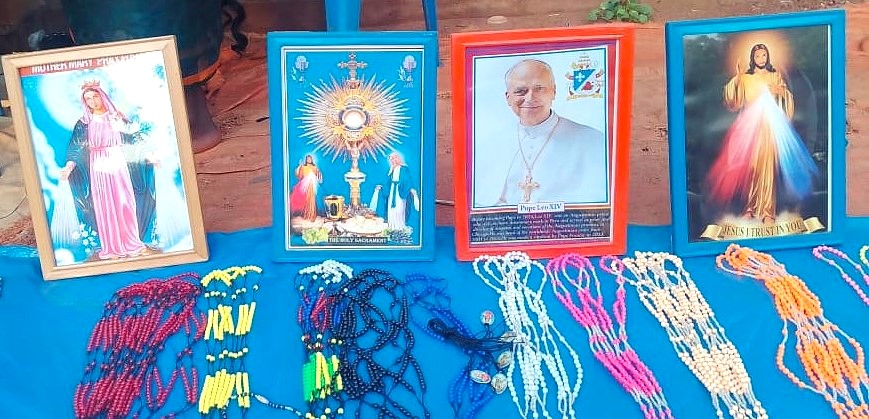
These are devotional articles commonly used in Marian and other approved devotions within the Church. They serve as valuable aids to prayer and should therefore be treated with reverence and respect.
Nevertheless, it is erroneous to think that these objects possess power in themselves. Their purpose is to assist the faithful in prayer. Every prayer offered with these devotional articles is ultimately directed to God through the intercession of the Blessed Virgin Mary or the saints.
Rosary
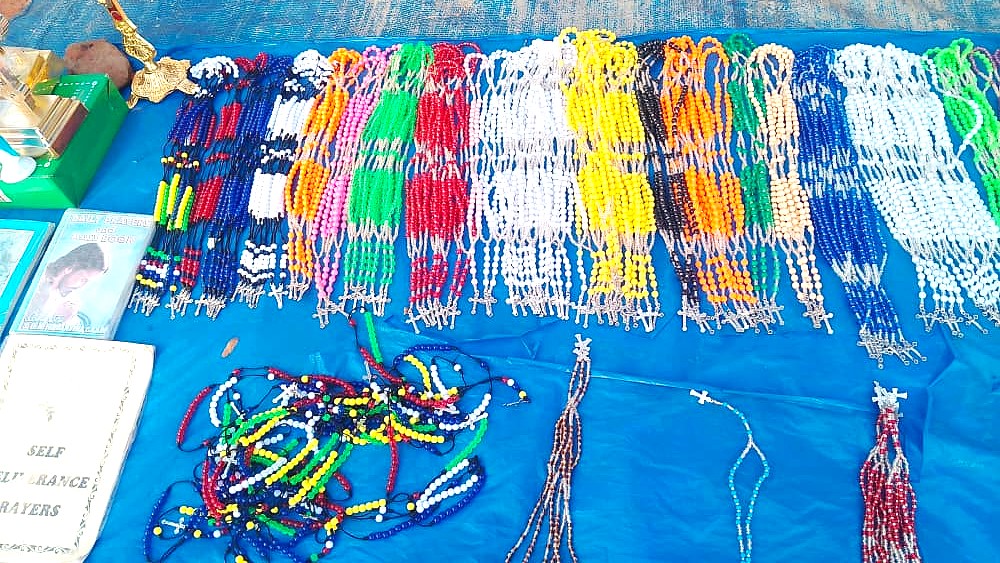
The Rosary is a devotional aid that assists the faithful in meditating, together with the Blessed Virgin Mary, on the mysteries of Christ’s saving work.
It consists of a crucifix, three introductory beads leading to the centre medal, and five decades separated by larger beads for the Our Father.
The Rosary is fundamentally a scriptural and meditative prayer.
Pope St. John Paul II describes it as “a prayer loved by countless Saints and encouraged by the Magisterium” (Rosarium Virginis Mariae, 1). Although it is a Marian devotion, it “is at heart a Christocentric prayer.” He further observes that “in the sobriety of its elements, it has all the depth of the Gospel message in its entirety,” making it “a compendium of the Gospel.” Through the Rosary, the faithful receive abundant graces “as though from the very hands of the Mother of the Redeemer.”
Besides the Rosary of the Blessed Virgin Mary, other forms of prayer have developed using similar beads, commonly known as chaplets, such as the Chaplet of Divine Mercy and the Chaplet of the Precious Blood.
Scapular
The scapular consists of two small rectangular pieces of wool joined together by strings and worn over the shoulders.
Its origin lies in the religious habit worn by monks, where a long piece of cloth draped over the shoulders served initially as a work apron before acquiring profound spiritual symbolism. It came to represent the yoke of Christ borne by those wholly dedicated to His service, reminding them of humility, obedience, and faithful service.
Later, the faithful adopted a smaller version as a sign of sharing spiritually in the life and devotion of particular religious communities.
The most familiar is the Brown Scapular of Our Lady of Mount Carmel, originating from the Carmelite Order. It is worn as a sign of consecration to Our Lady and trust in her maternal protection.
Other scapulars include the Green Scapular, bearing the image of the Immaculate Heart of Mary; the Red Scapular in honour of the Passion of Christ; and the White Scapular, symbolising devotion to the Holy Trinity.
Like the original monastic scapular, these devotional scapulars remind Christians to take upon themselves the yoke of Christ (cf. Matthew 11:29).
Medals
Devotional medals are small pieces of metal, often coin-shaped, bearing sacred images or inscriptions.
They are worn in honour of Christ, the Blessed Virgin Mary, or the saints as signs of devotion and as reminders to seek God’s grace through their intercession.
Among the best-known is the Miraculous Medal of Our Lady of Grace, depicting the Blessed Virgin Mary on one side and the Marian monogram on the reverse.
A Pastoral Note
All devotional articles are instruments of prayer and piety. They should never be regarded as possessing magical powers or used in the manner of pagan amulets.
It profits little to wear a Rosary around one’s neck without praying it, or to wear a scapular or medal without cultivating a genuine relationship with Our Lady or the saints through prayer.
These devotional articles derive their true meaning from the life of prayer. Without prayer and faith, they become nothing more than ornaments or, worse still, objects treated superstitiously as charms.
4. Sacred Paintings and Sculptures
From the earliest centuries of Christianity, sacred paintings and sculptures have been much more than decorative works of art. They have served—and continue to serve—as visible expressions of the mysteries of faith, making divine realities more accessible to the faithful.
Every sacred image seeks to communicate profound theological truths.
The Catechism of the Catholic Church teaches:
“The sacred image, the liturgical icon, principally represents Christ… the incarnation of the Son of God has ushered in a new ‘economy’ of images” (CCC 1159).
It further teaches that:
“Christian iconography expresses in images the same Gospel message that Scripture communicates by words” (CCC 1160).
What Then Is the Meaning of the Prohibition in Exodus 20:4–5?
In this passage, God forbids Israel from making images for the purpose of worshipping them as gods. The prohibition is therefore directed against idolatry, not against sacred art itself.
Indeed, elsewhere in Exodus, God commands Moses to make two golden cherubim to stand upon the Ark of the Covenant (Exodus 25:18). Likewise, in Numbers 21:8, God instructs Moses to make the bronze serpent through which He brought healing to His people.
On the other hand, God strongly condemns the golden calf because the Israelites worshipped it as their god (Exodus 32:1–10).
Sacred images therefore become valuable when they lead us to contemplate God’s glory. They become sinful only when they replace God and become objects of worship.
Sacred Images and the Liturgy
The Church teaches that “all the signs in the liturgical celebrations are related to Christ” (CCC 1161).
Thus, even when sacred images of the Blessed Virgin Mary or the saints are displayed, they ultimately direct our attention to Christ, who is glorified in them.
Through these holy images, the faithful become more deeply aware of the “cloud of witnesses” who continue to accompany the Church and intercede for us, especially within the sacramental life of the Church.
Sacred Images and Church Tradition
It is the responsibility of the Church’s Magisterium to preserve both the written and unwritten traditions handed down through the centuries.
Representational sacred art forms part of this living tradition. It developed alongside the Church’s mission of evangelisation and bears witness to the reality of the Incarnation. Since the Son of God truly became man, His human image can legitimately be represented—not as an object of worship, but as a means of contemplation.
The earliest Christians, even during times of persecution, decorated the catacombs with symbolic images such as the Good Shepherd, the fish, and the anchor.
After Emperor Constantine granted religious freedom in the fourth century, Christian painting, mosaics, and sculpture flourished throughout the Church.
For this reason, the Church continues to encourage the use of sacred images in churches, homes, sacred vessels, vestments, and other places where they help the faithful contemplate the mysteries of salvation.
As the Catechism reminds us, through meditation upon sacred images, together with Sacred Scripture and the Church’s liturgy, the mysteries of our faith become deeply impressed upon our hearts and are reflected in our Christian lives (cf. CCC 1162).
Christian art remains an important source of prayer, inspiration, and catechesis.
At Uganda Martyrs Cathedral, Lira, for example, one finds numerous paintings, including beautiful stained-glass artwork created by Br. Vittorio Fanti, a Comboni missionary, at the request of Bishop Cesare Asili. These paintings—including scenes such as the Fall of Man, the Good Samaritan, and the Last Supper—continue to serve as valuable tools for catechesis. Indeed, as a catechumen in 1999, I vividly recall how our catechist used these very paintings to teach us the mysteries of our faith.
As we conclude this reflection on the various objects used as sacramentals, we are reminded that these sacred signs are intended to strengthen our faith, deepen our prayer, and lead us into a closer relationship with Christ. Their value lies not in the material from which they are made, but in the faith with which they are used and the grace of God to which they direct us.
As we continue journeying together through this series, feel free to send in any questions you may have regarding the teachings of the Church on the Sacraments and sacramentals for clarification in future reflections.
Diocesan Pastoral Coordinator, Rev. Fr. Vincent Orum Nimungu
By Flavia Oyuu, Communications Office, Lira Diocese
LIRA – Priests, religious, family members and the faithful gathered at St. Daniel Comboni Diocesan Headquarters, Bar Ogole, on Saturday, July 25, 2026, to commemorate the first anniversary of the late Rev. Fr. Ponsiano Okalo, with a renewed call to carry forward his legacy of joyful priestly service, faith and compassion.
The memorial Mass was led by the Diocesan Pastoral Coordinator, Rev. Fr. Vincent Orum Nimungu, and concelebrated by Rev. Fr. James Michael Ebong, before proceeding to the blessing of the late priest’s grave where special prayers were offered.
Fr. Ponsiano died on July 25, 2025, at St. John XXIII Aber Hospital after serving the Church for 25 years. At the time of his death, he was a lecturer at Lira University, Episcopal Vicar for the Clergy and curate at Ober Catholic Parish. He was only weeks away from celebrating his Silver Jubilee in the priesthood.
In his homily, Fr. Orum encouraged the faithful to look beyond death and embrace the Christian hope of resurrection, comparing Fr. Ponsiano’s life to a flowering plant that continues to live through its seeds.
“The flower may wither after fulfilling its mission, but it leaves behind seeds that bring forth new life. In the same way, Father Ponsiano is not dead. His life continues, and that is the hope Christ gives us through the resurrection,” he said.
He described the late priest as a man whose life was measured not by its length but by its quality, recalling his ever-present smile, gentle spirit and dedicated ministry.
“The quality of life that he lived is what matters before God. He was a beautiful flower that God planted among us,” Fr. Orum said.
Drawing from the Gospel, he reminded Christians that Christ’s promise, “I am the resurrection and the life,” remains the source of consolation for believers and urged the congregation to remain faithful to the Eucharist, describing it as the path that prepares Christians for eternal life.
“The greatest gift we can give Fr. Ponsiano is to remain close to Jesus in the Eucharist—the same Eucharist he celebrated and shared with God’s people throughout his priestly ministry,” he added.
Angelo Jacinta Kula, his wife and family flanked by the Mother General and Missionary Sisters of Mary Mother of the Church, MSMMC
Remembering his son, Mr. Angelo Jasinta Akula, who served as a catechist for 56 years across what was then Gulu Diocese, thanked the faithful for their continued love and support shown to the family.
He urged those still grieving to celebrate Fr. Ponsiano’s life by continuing his mission rather than remaining in sorrow.
Mr. Kula paid special tribute to Christians of Ober Parish for standing with priests and supporting God’s servants throughout the years.
He also announced that the family will host a posthumous celebration of Fr. Ponsiano Okalo’s Silver Jubilee in the priesthood and his birthday on August 11, 2026, at their home in Bala Sub-county, Kole District, inviting Christians across the diocese to participate.
Also speaking during the memorial, Judith Abude, the Vocations Coordinator of St. Peter Claver Ober Parish, called upon Christians not only to pray for departed priests but also to remember those still serving.
“Many people seek prayers from priests every day, but we often forget that they too need our prayers to overcome the challenges they face in ministry,” she said.
Paying tribute to the late priest, Carlos Okwada described Fr. Ponsiano as “a priest of substance,” recalling his gift as an educator and trained psychologist whose counsel comforted the broken-hearted and restored hope to many people.
Throughout the celebration, family members participated in the offertory procession while the choir led hymns of hope and thanksgiving before the congregation proceeded to the cemetery for the blessing of the grave.
One year after his passing, the memorial celebration became more than a remembrance of a beloved priest. It was a renewed invitation for the faithful to emulate Fr. Ponsiano Okalo’s joyful witness, compassionate service and unwavering faith, ensuring that the seeds he planted continue to bear fruit in the Church and society.
By Fr. Isaac Ojok, Communications Office, Lira Diocese
The Metropolitan Archbishop-elect of Addis Ababa, Ethiopia, Most Rev. Tesfaye Tadesse Gebresilasie, has outlined key insights on young people drawn from the Final Document of the Synod on Synodality during the ongoing 21st AMECEA Plenary Assembly in Nairobi.
Addressing the delegates on Tuesday, July 21, Archbishop Tesfaye, a member of the Comboni Missionaries of the Heart of Jesus (MCCJ), reflected on four key lessons from the synodal journey: about young people, directions for youth ministry after the synod, and the pastoral responsibility of bishops in accompanying young people.
Synodality: A Continuing Journey
The Archbishop-elect emphasized that synodality is deeply rooted in the tradition of the early Church, citing Acts 15 as an example of the first synodal experience. He noted that the current synodal journey is a continuation of this heritage.
He recalled that Pope Francis, while marking 50 years since the institution of the Synod of Bishops by St. Paul VI, stressed that synodality is not optional but essential to the Church’s life. With 2026 dedicated to receiving the final synodal document, Archbishop Tesfaye urged local Churches to actively embrace and implement its vision.
He further described synodality as a journey rather than a destination, serving the Church’s mission of evangelization. Guided by the Holy Spirit, the synodal process calls for ongoing consultation, discernment, and concrete action at the local level.
Synodality as Conversion
The Comboni Archbishop underscored that synodality requires a spiritual conversion that shapes the daily life of the Church. This transformation, he said, involves all members of the Church, bishops, priests, religious, and the laity, learning to live and act in a more synodal way.
He encouraged local Churches within AMECEA to continue fostering structures and pathways that promote participation, dialogue, and shared responsibility.
Young People at the Heart of Renewal
Turning to the place of young people in the synodal process, the Archbishop noted that while the synod was not exclusively about youth, it recognizes them as both vulnerable and vital contributors to the Church’s renewal.
He highlighted that young people bring a strong sense of community and are active participants in the life of the Church. The document calls for their meaningful inclusion in decision-making bodies such as parish pastoral councils and diocesan structures not merely as observers, but as contributors to discernment.
The Archbishop also pointed to the growing role of families and institutions in supporting young people, emphasizing the importance of intergenerational dialogue and collaboration.
A Synodal Approach to Youth Ministry
The Ethiopian Prelate stressed that youth ministry must itself be synodal, rooted in listening, accompaniment, and shared journeying. He called for renewed methods and language that resonate with contemporary youth culture, noting that some traditional approaches are no longer effective.
He emphasized the need to spend time with young people, listen to their experiences, and recognize the action of the Holy Spirit in their lives. He said young people are not just recipients but agents of youth ministry.
Pastoral Responsibility of Bishops
On the role of bishops, Archbishop Tesfaye highlighted the growing need for authentic relationships among young people, many of whom are increasingly drawn into virtual interactions at the expense of real human connection.
He called for a “conversion in relationships,” beginning within families and extending to Church communities. Bishops, he said, must be visible signs of hope, inspiring young people to believe in the possibility of change.
The Archbishop also drew attention to the challenges faced by youth, including various forms of abuse, emotional, spiritual, political, and social and urged Church leaders to be prepared to address these realities with compassion and competence.
Call for Coordinated Action
The synodal document, he noted, calls for stronger coordination among diocesan structures, religious congregations, and Church movements working with young people. Bishops are tasked with fostering unity and collaboration to ensure a coherent pastoral approach.
He further highlighted the need for establishing or strengthening youth offices at the diocesan level and promoting synodal formation in seminaries and among candidates for consecrated life.
Navigating the Digital Age
Addressing emerging challenges, Archbishop Tesfaye warned of the risks associated with the unchecked use of artificial intelligence and digital technologies among young people. He called for clear guidelines and formation to help them engage responsibly with these tools.
A Question for the Church
Concluding his reflection, the Archbishop echoed a central question raised by the synod: How can the Church ensure that young people fully participate in its life and mission?
He urged Church leaders across AMECEA to take concrete steps in making the Church a more inclusive, participatory, and hope-filled community for the younger generation.
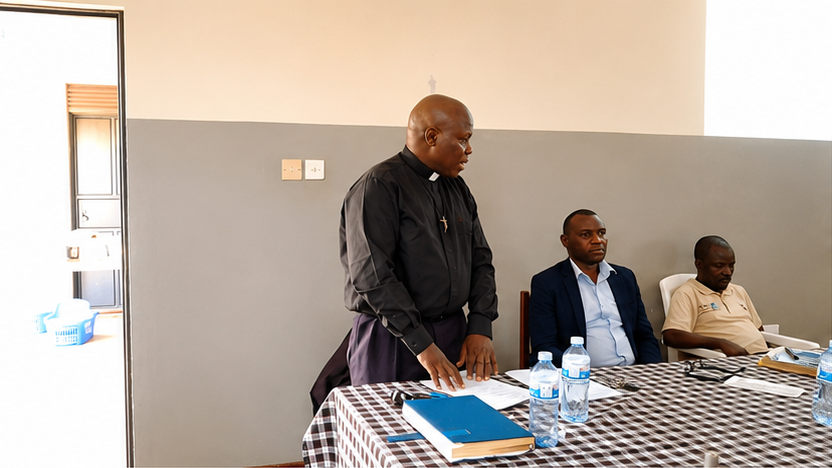
Diocesan Pastoral Coordinator, Rev. Fr. Vincent Orum Nimungu opening the Bible Society of Uganda workshop at Nazareth Family Center, in Bar Ogole, Lira Diocese
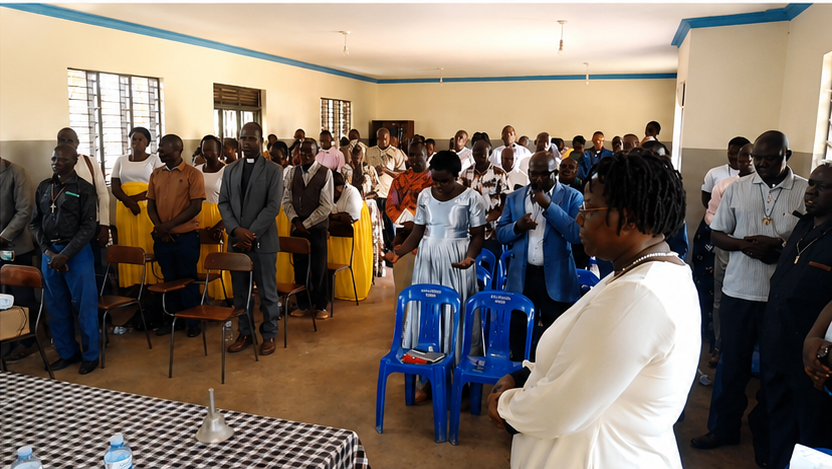
The Bible was launched on Friday, July 24, during a one-day Church leaders’ sensitisation workshop held at Nazareth Family Centre in Bar Ogole. The workshop brought together priests, religious, catechists and lay leaders to learn about the Bible Society of Uganda’s ministry, including Scripture translation, trauma healing, youth programmes and support for people with visual disabilities.
By Flavia Oyuu, Communications Office, Lira Diocese
LIRA, Uganda – Lira Diocese, in partnership with the Bible Society of Uganda, has launched the revised edition of the Lango Catholic Bible (Buk Acil), ending more than five years during which the publication had been unavailable and encouraging Catholics to deepen their encounter with God’s Word.
The Bible was launched on Friday, July 24, during a one-day Church leaders’ sensitisation workshop held at Nazareth Family Centre in Bar Ogole. The workshop brought together priests, religious, catechists and lay leaders to learn about the Bible Society of Uganda’s ministry, including Scripture translation, trauma healing, youth programmes and support for people with visual disabilities.
Opening the workshop on behalf of Bishop Rt. Rev. Sanctus Lino Wanok, the Diocesan Pastoral Coordinator, Rev. Fr. Vincent Orum Nimungu, described the Bible apostolate as an important avenue for renewing evangelisation and strengthening missionary discipleship in the Church.
Quoting Pope Francis’ Apostolic Exhortation Evangelii Gaudium, Fr. Orum reminded participants that “the joy of the Gospel fills the hearts and lives of all who encounter Jesus,” noting that the Scriptures remain the primary way through which Christians encounter Christ and listen to the voice of the Holy Spirit.
“In today’s society, we are bombarded by many voices and noises, leaving little time to listen,” he said. “The Holy Spirit communicates to us through the Gospel in the Bible. Therefore, we are called more than ever to become a listening Church.”
He encouraged Christians to rediscover the transforming power of Scripture in their daily lives, saying the Bible apostolate empowers believers to become joyful missionary disciples capable of bringing hope to society.
Bible Society of Uganda, Fundraising Assistant Jesse Mungalo
Speaking on behalf of the Bible Society of Uganda, Fundraising Assistant Jesse Mungalo explained that the organisation serves all Christian denominations through Bible translation, publication and distribution.
He said the Society has so far translated the Bible into 21 Ugandan languages, including Lango, while also producing Braille and audio Bibles to ensure that people living with visual impairment are not left behind.
“This week we have been meeting leaders from different Christian denominations across Lira. Today we are with Catholic priests, catechists and church leaders, sharing the work of the Bible Society and introducing the revised Lango Catholic Bible, which is now available again after being out of stock,” Mungalo said.
He appealed to Christians to obtain and actively use the Scriptures, noting that the Society’s vision is for every Ugandan to have access to the Bible in a language they understand.
The Vicar for Clergy of Lira Diocese and consultant to the Bible Society of Uganda, Rev. Fr. Dr. Polycarp Opio, welcomed the reprinting of the Lango Catholic Bible, describing it as good news for the faithful.
“We are happy to receive the reprint of the Bible in Lango, Buk Acil. This is a great testimony and good news in our diocese,” he said.
Fr. Polycarp also encouraged parishes and church groups to take advantage of the Bible Society’s trauma healing programme, youth initiatives and other outreach programmes, saying they provide valuable support for communities.
“I am empowered to go back, mobilise support for the Bible Society and encourage our people, especially the young, to participate in its mission,” he added.
Vicar for Clergy of Lira Diocese and consultant to the Bible Society of Uganda, Rev. Fr. Dr. Polycarp Opio
Closing the workshop, Fr. Orum thanked the Bible Society of Uganda for strengthening participants’ understanding of Scripture ministry and raising awareness about programmes that support vulnerable groups, particularly people living with blindness.
He called on Catholics to become members and supporters of the Bible Society while embracing regular Scripture reading.
“As Catholics we need to own the Bible because, as St. Jerome said, ‘Ignorance of Scripture is ignorance of Christ,'” he said.
He further noted that the diocese had actively participated in several Bible Society activities throughout the week, including programmes for women and youth, expressing confidence that the partnership would bear lasting fruit in strengthening biblical formation across the diocese.
The newly revised Lango Catholic Bible incorporates revisions suited to Catholic liturgical and pastoral use after many years in which Catholics largely relied on the Anglican Luo Bible due to the unavailability of the Catholic edition.
An initial 5,000 copies have been printed and are now available through the Diocesan Procure in Ngetta.
 English
 Arabic
 Chinese (Simplified)
 Dutch
 French
 German
 Italian
 Portuguese
 Russian
 Spanish